Saturday, April 13, 2019

What I'm trying now... Qigong

I've been exploring Qigong (chi-GUNG), which is related to Tai Chi, and which I've learned about from my Tai Chi teacher.  Since my teacher has been ill, I've been pursuing this on my own, via books and online courses, as well as continuing what I learned in class.


This exploration lead me to Bianca Molle, who seems to have beat back PD by spending three hours a day doing Qigong; she used DVDs from Mington Gu who now has online courses at  The Chi Center.     I took his online class for some time, but, frankly, it moved too slowly for me after awhile. 

Then I looked into what Bruce Frantzis has to offer, as he has some really well-thought of books and courses.  I have been reading his book about Dragon and Tiger Qigong (which is Qigong specially designed for healing).  I learn physical things by watching and following along, so I have been taking an online course from one of his students, Bill Ryan; this has been enormously helpful for helping me learn the Dragon and Tiger form, combined with the book. Also recently have returned to Dr. Paul Lam's DVD/download Tai Chi classes.  While the Qigong leaves me feeling refreshed, it doesn't do much to challenge my balance, and the Tai Chi provides that.

Right now, I spend 30-45 minutes a day working on my practice.  Practice has multiple meanings, including - to repetitively work on something to get better at it.

The Davis Finney Foundation funded research that evaluated many existing studies (called a meta-study) and found that Tai Chi and Qigong do help PD symptoms. 

I've been doing  a variety of Qigong practices for about 6 months.  I've noticed an improvement in non-motor symptoms:  urinary urge is less, sleeping better (able to return to sleep more quickly), small motor skills like typing and writing have improved a little.  Dry eyes are a bit better, too.  Cognition is a bit better - less problems with word-finding (long may that last).  On the other hand, rigidity and slowness are the same, as is blood pressure (too low).  The one thing that's not getting better that I really want to improve, still, is balance - trouble with stairs and curbs, lurching like a drunk.  Grrrrrr.  Still, there are brief times (under a minute) when my walking is normal, which hasn't ever happened, so I'm keeping an eye on this.

Lam and Frantzis images from Amazon. 

Sunday, March 3, 2019

What's wrong with clinical trial process? A participant's perspective

I really want researchers to find ways to slow or reverse progression of the disease, and to find ways to make the many symptoms less bothersome (insomnia, urinary incontinence, lack of appetite...)  So I'm motivated to participate in research (which means clinical trials - see this article for more information).
From PDTrialTracker.Info
Here's what has happened when I tried to sign up for clinical trials:
  • When I was first diagnosed, and not taking any meds yet, I contacted the local research center who said... Oh, we're not doing any studies on PD now.  They could not have sounded more bored.  And though I left email, phone, address, they have not contacted me.  Not once.  In two years.
  • I called a trial in a neighboring state, but they wanted me to go there once a month for a year.  This means my husband would have to drive me at least 12 times, as I can't drive that far any more. (A train takes longer, and unexpectedly requires climbing up or down steps - not remotely disabled-friendly.)
  • When I looked for trials anywhere within driving distance recently, the only trial I could participate in was a 3 hour drive one-way, and required repeated visits.  Not near public transport - and in the middle of nowhere.  Um, who is going to go there?
  • I was looking through trials, and one looked possible, until I noticed that, not only do they want monthly visits, they want to do a lumbar puncture at each visit (that's a puncture of the spine to get spinal fluid).  That means, at the very least, a blinding headache.  I have to ask the clinicians who dreamed this up:  would you be willing to have this procedure performed on you once a month?
  • Tried to enroll in a study about tracking PD symptoms on a Smartphone - twice.  Once was a Samsung phone; one an iPhone.  I had problems with the software on both phones.  Emailed the contact person - in one case, after instructing me to re-install the software, the response was, I guess it doesn't work with your phone.  With the other phone, never got an answer. 
  • Clinicians had come to a local conference of pwp looking for participants in their trial.  It sounded intriguing, and didn't involve any dangerous testing.  When I was screened by the clinician later, because I have atypical Parkinsonism (no tremor, but balance issues), she suddenly wasn't interested.  Well, if you're still doing well in a year, give me a call; if we're having trouble getting participants then we can include you.  That was welcoming.
  • A guy in a suburb of a major city emails me about his trial - 6 hour drive one way - but he thinks I should participate, and be happy to go there monthly.  His tested treatment happens to be known to make another medical condition that I have worse. so I wouldn't consider it; he is sure it's not a big deal and is perfectly willing to risk my health for his trial.  Update:  When I looked up this trial, it wasn't recorded on ClinicalTrials .gov, although it probably should be, by US law.  So who is looking out for the human beings in this trial?
  • I've registered on Fox Trial Finder, as well as several other "I'm interested in participating" websites.  Do I ever hear from any of them about new trials?  Rarely to never.
  • I do hear from one company that does clinical trial work for large pharmaceutical companies.  What they call me about:  Phase 1 trials of some unknown compound; this is a study to find out if the compound is even safe to use.  They seem uncomfortable when I ask the question, "Is this a Phase 1 or Phase 2 trial?" Scientists do Phase 1 trials on a small number of patients, so if it's dangerous, not too many are harmed.  And did I mention that any resulting harm to my health is entirely my problem?  Oh, and it requires a lengthy drive once a week for as long as the trial goes on (which my husband would have to do). Sounds appealing, no?
I regularly look at ClinicalTrials.gov to see what possibilities are out there.  I'm not diagnosed less than 2 years any more, and I'm not "drug naive" (not taking any PD meds); there go most of the trials.  The few I could still participate in usually don't want me because I'm atypical.  There are a few trials I could do if I was demented or having hallucinations (um, no) or if I'm willing to drive for hours weekly.

In sum, besides the almost standard desire for less than 2 years from diagnosis and drug naive, which is a tiny subset of PD patients, there seems to be a willingness to inconvenience the patients (and their families), casually put them in danger, and generally use them and then spit them out.

Pwp who have been through the actual trial process on potential drugs are equally frustrated by disorganized researchers, being cut off from a treatment that helped their condition improve because the trial is over, and then never being told the results of the study - and since 40% of trials NEVER publish their findings, they might never know. Some of these pwp don't want to be used again, and can you blame them? (See some of Christopher Maycock's excellent thinking on this topic.)

What could attract me, and other pwp, to clinical trials?
  • Being treated like a valued customer, not a used kleenex.
  • Recognition that my participation involves inconvenience and possible exhaustion. Telemedicine, anyone?
  • Treat me like an interested partner - I might have insights that could help you reduce the barriers that are making recruitment hard, as well as insights about what success in the trial would mean to me, the PD patient.  
  • Look to include many different kinds of pwp because you don't know which group of us will be helped by your drug/procedure/device. 
  • Recognize that I might be risking my health - and plan for that eventuality with insurance (I should not be out of pocket if I'm harmed).
  • Tell me about your results and what the next steps are.  For example, can I be involved in the next wave of testing? 
  • Provide my physician with all test results and what I was dosed with.  
I don't think any of this is too much to ask.  To their credit, there are researchers that do a lot of this.  Why don't all researchers do this?


Sunday, February 17, 2019

Want to participate in PD research?

Much of PD research that patients and their loved ones are interested in has to do with drugs that may slow or even reverse the direction of the disease.  There are also studies about exercise and physical therapy, and even studies trying to find some commonality among people who don't have genes that predispose them to PD.  For the basics of how these studies operate, see ClinicalTrials 101.  

If you’re interested in participating in research, here are some good sources to help you find trials that are recruiting participants near you:

  • If you’re in the UK (United Kingdom), Parkinson’s UK maintains a database of trials that helps you find trials near where you live. 
  • If you live in the US, the FoxTrial Finder is a good place to start.  I’ve found them good for initial screening of trials, but their feature to notify me of new trials doesn't seem to work, so I regularly go to the following source, too.
  • The source for most of this information is the ClinicalTrials.gov database, which includes most international trials as well as US-based trials.  This article explains how to use it.


What if the Press has a story about a "breakthrough?  Where can I find more information?  

What trials are going on right now?

What if I'm only comfortable with trials without drugs?  See Observational Studies. Image from Pixabay.

Suppose I want to know the results of a Clinical Trial?


Here’s an ugly truth – even though Clinical Trials need pwp (and sometimes people without Parkinson’s), about 40% of these studies never publish their findings* (this is true for all research there, not just for PD).  Note that NIH and Michael J. Fox Foundation, among others, make publication of results a requirement of funding; wish all funders had such a requirement.

Fortunately, there are several ways to find out the results.  First, make sure the study has finished.  Instead of the status of Recruiting, it will be Completed in ClinicalTrials.gov.  (See this article for more information about using ClinicalTrials.gov.)

In all cases, you’ll search in Pubmed.gov, a database of biomedical journal research articles from the US and the international research community.  Usually a summary (called an abstract) of the article is available, with a link to the entire article;  sometimes the article itself is free, but sometimes it’s behind a paywall (meaning you must pay the journal to see the article).

You can search Pubmed with keywords, just like Google. Why not just use Google?  Because Google will give you many confusing records you'll need to weed through; Pubmed is easier  For a lot more about usingPubmed, see this article.  

1.  The easiest way to look for a possible journal article is to search for the NCT number (National Clinical Trial) on the Pubmed.gov database, since some researchers refer to the NCT number in their papers. Just enter the NCT number (found throughout the ClinicalTrial.gov record) into the search field at Pubmed.gov as in the example above. 

Here's an example of the start of an abstract that could result from such a search.  You can see the link(s) to the full article on the right.

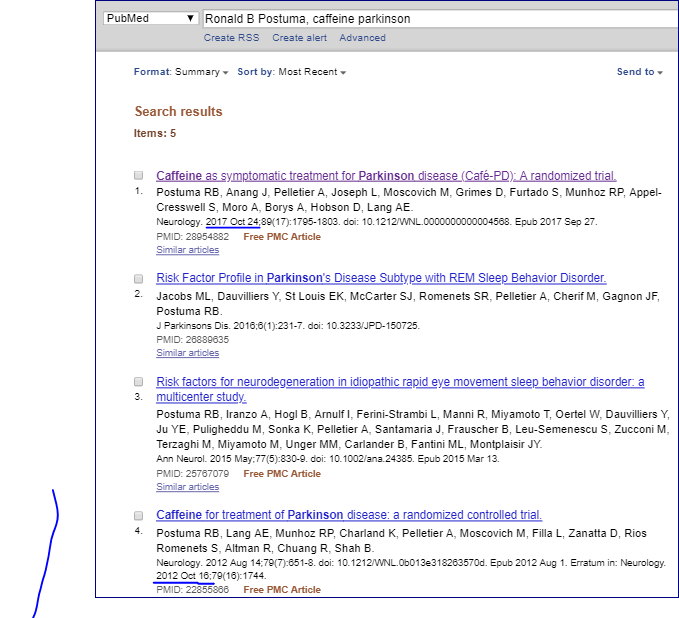
2 . Entering the NCT number didn’t work?  Put on your detective hat.  From the Clinical Trial record for this study, get the name of the Principal Investigator (scroll down to the bottom of the Tab called Tabular View.) Then look for the title of the study (at the top); you may also have to read the summary paragraph that explains what the study is about.  From these, pull out what you think are the important keywords – for example, name of drug or device or technique used.

In the Pubmed.gov database, in the search bar put the keywords and the Principal Investigator’s name.  You may also need to add the term Parkinson.  See the example below:


There may be nothing, or multiple articles.  If the title doesn’t tell you enough to decide which is the right article, compare the Completion Date from ClinicalTrial.gov with the publication date of the articles; the publication date is usually at or later than the Completion Date; this was done in the example shown above, choosing the 2017 article because it comes a few months after completion.

3.  If none of the papers deal with the clinical trial, there's one more place. Often you'll find an email address associated with the Principal Investigator in the Clinical Trial database, so you could email this person to ask about publication of results.  There may be a paper that you didn’t find, or the paper may be in the process of being published, so you don't want to assume they didn't publish. Here’s an example email:  “I’ve been looking for the paper that describes the results of NCT12345678. Title of Study.  Can you help?” If they have a paper, they can provide the link.  If they don’t have a paper, you may have managed to make them feel a bit embarrassed, all while staying completely polite yourself, and not risking embarrassment.  (Take the high road.)   

4. By the way, if somebody gives you a DOI number (used in electronic publishing), go to dx.doi.org, enter the number in the search box, and you’ll go right to the summary and/or article. (Google will give you confusing choices.)

5.  If none of these work, you've struck one of the 40%.  Studies that use US government money are required to publish their results.  Shouldn't funders from companies, foundations, and universities require the same?

*Wyant, Kara J., Yasuda, Erica, Kotagal, Vikas. “The 10‐Year Landscape of United States‐Registered Parkinson Disease Clinical Trials: 2007–2016.” Movement Disorders, Wiley InterScience, 4 Oct. 2018,  onlinelibrary.wiley.com/doi/abs/10.1002/mdc3.12665.

Using ClinicalTrials.gov

ClinicalTrials.gov is the database; it contains virtually every clinical trial being done anywhere.  A clinical trial is a study of the use of drugs, devices, or procedures with human beings to improve human health, so if you want to know about studies being done now, this is the place to go.  Researchers in the US are required by law to describe most trials here; many researchers elsewhere do, too, since US medical journals won't publish their results unless the trial is listed here.  And anybody in the world can search this database.
(In fact, completed studies going back as far as 2007 are here, too, so there is a wealth of information available at your fingertips.)

Here's the basic search screen:
PWP and their families are often interested in finding studies to participate in.  You can pick studies that are recruiting (that is looking for people to participate), or not yet recruiting (but will be in future), Parkinson Disease (notice they've dropped the 's), and once you pick the country, it will let you pick a city and how far you're willing to travel from there.  Here's an example.  I searched for trials that are recruiting, about PD, in the US, and within 50 miles of New Haven CT.  The search box looks like this:
The list of results starts like this:
and if I click on one of the studies that interests me, I can find out much more.  The link for information about who to contact is highlighted in the example below.  
ClinicalTrials.gov publishes a great deal of information, including how to search, how to use search results, and how to read a study record (which is what you would use to find out more about this Phase 3 study example).

For definitions of some of the unfamiliar terminology, see the Fox Trial Finder website. 

One very important warning:  while this is a government database, the US government does not check studies for safety, or even that they are real clinical trials.  This means you need to ask a lot of questions about safety of both the drug/device/procedure, and any testing being done to monitor the trial. This also means you need to watch out for the slimy businesses that use ClinicalTrials.gov as advertising for their unproven and dangerous products.  Instead of testing their experimental products on you for free (a real clinical trial), they want thousands of your dollars (run!)  

For example, stem cells.  The real stem cell clinical trials accept a very small number of participants and take years to see results; the procedure requires brain surgery, and new neurons take years to grow from implanted stem cells.  The fake "trials" use unproven technology, accept any adult in the "trial," claim miracles, and don't even have a good track record with basic sanitation - but they want your money.  As I said: grab your wallet and run. 


Friday, November 23, 2018

Unexpected dystonia help

Dystonia, for those lucky enough to not experience is, is often related to PD and involves involuntary and often painful pulling or twisting of body parts, including legs and feet, or head and neck;  it is treated with medication and sometimes Botox injections.  I didn't have dystonia in my feet all the time, or even every day, but it was a regular visitor, especially in the morning.

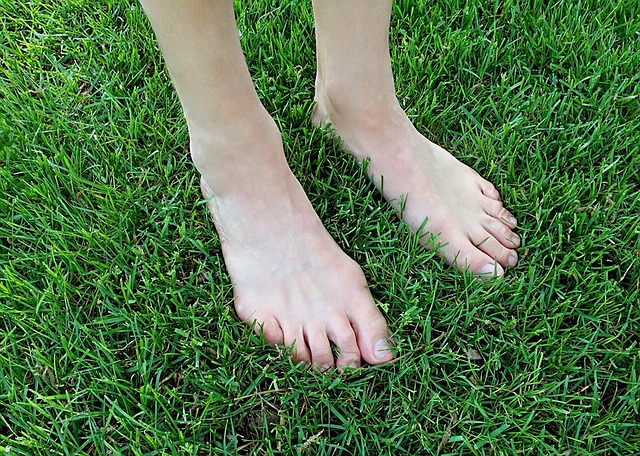
My husband was sure that earthing (also called grounding) would help my PD, because pwp have a lot of free-radicals, a lot of oxidative stress that goes on that can be countered by earthing.  Many scientists believe that this oxidative stress is involved with degeneration of neurons that make dopamine. It's believed that there are too many unbalanced electrons (the free-radicals), with not enough anti-oxidants created to balance them out. Here's an article from the UK's Cure Parkinson's Trust that explains it.  Think of the benefits of going barefoot in the grass - one of which is that extra electrons from the earth can balance out the extra unstable atoms in the brain.

There's actually some science behind earthing - which is a good thing because it's pricey so there ought to be some proof of concept.  See  this article for a review of recent research.

How did grounding help me?  After awhile, I realized that I wasn't waking up with cramped and twisted-feeling feet (they didn't look twisted, but they felt twisted).  Prior to that, the pain would often wake me.

Taking two grams of Vitamin C at bedtime had helped for awhile - Vitamin C is an anti-oxidant, working to get rid those free-radicals that can cause some of the physical damage of PD - but it was upsetting my stomach to take that much Vitamin C at once.  My husband put a grounding sheet on the bottom of my bed.  There's always some skin touching it, even in cold weather, in between my socks and PJs.

We have a grounding pad under my feet in the living room, and in warm weather, that provides grounding, too.  When we camp - in warm weather - I'm outside a lot; while not barefoot, I do touch the ground, so that seems to help ground me, and dissipate the oxidation. I don't take the grounding equipment when we camp; I have a little dystonia sometimes when camping, but not much.

In the winter, I'm always wearing socks, which makes the grounding pad in the living room useless, so I count on the grounding sheet on the bed.  But occasionally I leave on the compression thigh-highs that I wear - and then my skin isn't grounded in bed at all because all my skin is covered.   The first time the compression stockings interfered, dystonia woke me; then I held onto the grounding wire for about 10 minutes, which seemed to help the oxidation dissipate and the pain stopped.

Was this a clinical trial?  Nope.  Just me; N=1.  But if this helps one other person, it's worth it.

I've tried the less-expensive grounding wristband, but it's not comfortable, and I forget to take if off when I get up in the middle of the night (amusing for somebody watching, but less so for me).  As far as I can tell, this wristband is the same one used by people working with electronic components, to ground static electricity.  If you're interested to know more, Google earthing.

I was skeptical that this would work, and it wasn't instant, but then I realized my dystonia was gone.  I did not expect grounding to work, so I don't think this was a placebo effect (where you expect a treatment to work, so it does).  I occasionally get twinges of dystonia, especially when I'm tired, but that's it - quite a change from twisting muscle cramps that could wake me up, and continue irritating me for hours.  Exercise wasn't improving this, so I needed something else.  For me, grounding worked.  Long may it last.

Images from Pixabay.

Wednesday, November 14, 2018

Does gluten influence Parkinson's symptoms? Maybe...

Recently I was trying out a low FODMAP diet because I was having, ahem, digestive issues.  Low FODMAP cuts out the things that can be irritating so that you can ease up on your gut, then you slowly add them back to see which was bothering you - so you do without foods that contain dairy, vegetables like cauliflower, onions, beans...  and gluten.

I was tested for celiac about 10 years ago, and I didn't have it then, but I decided to cut gluten out, too, since I'd heard that some pwp felt it was helpful to cut out gluten.

After about a week, I started noticing that my balance - which has become rapidly worse and worse - was better.  Every once in awhile, my balance felt...  normal.  You must understand that balance has been the PD symptom that drives me the most crazy.   I was sure the low FODMAP diet would help my gut, and it did. My gut felt better, even if my diet was boringly bland.  But by week 2, my balance was still going in and out, but when I'm out of the house, I don't feel like I'm about to tip over. In the house I'm not cruising furniture, walls, and doorways. I'm still walking awkwardly (PD problem of long standing), but walking doesn't make me constantly feel like I'm on a funhouse ride.

I figured this might help my gut, and it has, but my balance?

I also notice that my stance isn't as broad.  I had been placing my feet wider and wider to give myself a stable base; not doing that now.

The last thing - those tiresome pins and needles in my right foot and hand are dissipating.  I still feel numb in my foot, but the tingling is almost gone.  Still feels a bit numb.  No impact on gut (but it turns out there are people who are gluten-sensitive who don't have abdominal symptoms).

All the rest of the annoying PD symptoms are still here:  excruciatingly slow handwriting, finger tap is still slower on my right,  I still walk like Lurch, I still have to run to pee (and then wait for all the pee to dribble out), I still can't smell a lot of things.  I still have orthostatic hypotension (if I'm not careful I can faint when I stand up).  My speech is still quiet.  I'm still stiff.  I still hunch forward when I forget to stand straight.   I still have trouble maintaining stability when I turn. I still have trouble remembering words, and still have problems with multi-tasking.

All the things that exercise has slowed progression on are still here (most of the list above).  The thing that exercise didn't improve (or slow down) was my balance and my neuropathy - and both are now better. Not perfect, but pretty much where I was a 6 months ago - I walk like a drunk and I have to remember to pick up my feet.  I still need a cane, but I'm no longer considering a rollator to make it easier to stay upright.

I've been adding back dietary items to see how my gut handles them, and they influence my gut - but I have not added back gluten.  Tried pea protein - no impact on balance.  Tried cooked onions - no impact on balance. Tried dairy - no impact on balance. Tried beans - no effect on balance.  If I eat something that has a little gluten in it - for instance granola made with organic oats, but not oats grown separately from wheat - my balance is off and my neuropathy-foot tingles.

Turns out, there is a gluten ataxia - balance.  Hmm.  There's even a gluten-caused neuropathy - the pins and needles.  Double hmmm.

I'm still watching to see if there will be more improvement.  Supposedly it takes about a month for your gut to heal itself from gluten if you have celiac.  Will it take that long for the inflammation that has been influencing my brain to dissipate?  Longer?  Will there be any permanent damage (and how could I tell)?

Update:  Oops, turns out I had some gluten and my balance went wonky.  Head suddenly felt like a tilt-a-whirl, but why?  Turns out the dry roasted peanuts I had been snacking on are packed in a facility that also packs wheat. It's called cross-contamination.  Who knew?  Also, corn starch turns out to be often contaminated, too, so I have to look for that, as well. Ticked off royally, because I was really enjoying being funhouse-free.  By the way, despite the crazy-feeling head, I have no gut disturbance.  But turns out that happens to some people.

Gluten-free eating is, let me tell you, a royal pain - it takes a lot of research.  But if this gives me back adequate balance, will I live with the inconvenience?  In a heartbeat.

Images from Pixabay.

Great tools to use during the Pandemic

Some organizations have stepped up for pwp who have lost socialization, and usually exercise programs and support groups.  Even for those ex...