If you live in the US, there is a terrific website with current information about Exercise and about Support Groups for each state. Parkinson & Movement Disorder Alliance has taken on the work of identifying each PD-specific Exercise group and Support group. They even have information about local, regional, and national organizations. Try to Google this yourself, and you will appreciate just how much work this is. Exercise groups will help improve your symptoms and may even slow progression - and can often become a support group, as well. Support groups provide a place to ask questions, discover local resources, and get support - for the pwp and for the care-partner/family.
https://www.pmdalliance.org/resources/
If you live outside the US, to find Parkinson's specific exercise, Google
Parkinson's exercise your-geographical-area
To find Parkinson's specific support groups, Google
Parkinson's support your-geographical-area
For a list of national/international Parkinson's organizations by world geographical area:
https://www.worldpdcoalition.org/page/Partners
A really great book for pwp and their families/friends is Every Victory Counts. Its focus is on how one can live well with PD. There are contributions by pwp, families and care-partners, physical therapists, doctors, and more. Included is information about diet, exercise, speech therapy, how to talk to your doctor, useful checklists, and much more. Best of all, it's free and downloadable online so that it's instantly available; a print version is often available, too. I have both. Kudos to the Davis Phinney Foundation for making this available and updating it regularly.
https://www.davisphinneyfoundation.org/resources/every-victory-counts-2017/
Other information that may help:
How to find info on research http://parkiesupport.blogspot.com/2019/09/where-to-find-latest-on-parkinsons.html
Who are all these PD organizations? http://parkiesupport.blogspot.com/2018/01/who-heck-are-all-these-organizations.html
What to know when first diagnosed http://parkiesupport.blogspot.com/2019/05/what-i-wish-i-had-known-being-first.html
Showing posts with label research. Show all posts
Monday, January 20, 2020
Monday, January 13, 2020
Exercise that's different - the Theracycle
One of the earliest discoveries about PD was accidental. A pwp rode a tandem bicycle with a doctor at Ragbrai, an annual cross-Iowa cycling event. She was pedaling faster than she would have, because of her partner - and by the end of the week, many of her PD symptoms had improved markedly. That experience grew into a whole series of experiments that demonstrated that when rats - and people - have to exercise faster than they ordinarily would, their PD symptoms improve (in the rats' case this was PD-like symptoms).
That Ragbrai experience on the tandem bike was forced exercise.
The Theracycle is reminiscent of a stationery bicycle, with important differences - it doesn't have a bike seat (and that's good, for there is very little comfortable about a bike seat), and it has a motor that enables you to pedal faster than you'd choose to pedal on your own. You could use it as a stationery bike, but you can have it assist you to go faster - that's the forced exercise.
There are cheaper versions of the Theracycle, but they lack a critical safety feature - do you want the bike to keep pedaling when your feet are attached to the pedals - if you fall off the bike? Me, neither. The Theracycle has a "deadman" switch similar to treadmills; you pin it to your clothing so if you fall the cord pulls a magnet off its target and the machine stops.
We purchased a Theracycle used, almost new, for under $2,000, less than half the cost of new (which would be $4,800 for this model.) My husband found it on Craigslist.
I gotta warn you - like a treadmill, it's boring. My husband, bless him, hooked up a tablet clamped to the right of the display, so I can watch Youtube.
For awhile I used the forced exercise aspect of the Theracycle, but it is a bit too energetic for my additional diagnosis (myelitis, which is similar to MS; see previous blog). Now, I'm only allowed to do moderate exercise, not vigorous at all - and when I do vigorous exercise now I end of stiff (unable to move stiff), exhausted for 24-48 hours, and sorry. This is frustrating since I became a real exercise nut before.
But I can stay on the Theracycle for long periods if I set the speed lower. Possibly I can build up to a faster speed at some time in the future. For now, I can work out at a lower speed but for quite awhile; typically I walk on the treadmill for 15 or 20 minutes, then use the Theracycle for 20-40 minutes more. If I'm tired, I skip the treadmill and use just the Theracycle. Even at the slower rate my legs are stronger.
So the Theracycle has been a boon for both conditions.
Image from https://www.theracycle.com/forced-exercise-bikes-for-pd/theracycle-200/
That Ragbrai experience on the tandem bike was forced exercise.
The Theracycle is reminiscent of a stationery bicycle, with important differences - it doesn't have a bike seat (and that's good, for there is very little comfortable about a bike seat), and it has a motor that enables you to pedal faster than you'd choose to pedal on your own. You could use it as a stationery bike, but you can have it assist you to go faster - that's the forced exercise.
There are cheaper versions of the Theracycle, but they lack a critical safety feature - do you want the bike to keep pedaling when your feet are attached to the pedals - if you fall off the bike? Me, neither. The Theracycle has a "deadman" switch similar to treadmills; you pin it to your clothing so if you fall the cord pulls a magnet off its target and the machine stops.
We purchased a Theracycle used, almost new, for under $2,000, less than half the cost of new (which would be $4,800 for this model.) My husband found it on Craigslist.
I gotta warn you - like a treadmill, it's boring. My husband, bless him, hooked up a tablet clamped to the right of the display, so I can watch Youtube.
For awhile I used the forced exercise aspect of the Theracycle, but it is a bit too energetic for my additional diagnosis (myelitis, which is similar to MS; see previous blog). Now, I'm only allowed to do moderate exercise, not vigorous at all - and when I do vigorous exercise now I end of stiff (unable to move stiff), exhausted for 24-48 hours, and sorry. This is frustrating since I became a real exercise nut before.
But I can stay on the Theracycle for long periods if I set the speed lower. Possibly I can build up to a faster speed at some time in the future. For now, I can work out at a lower speed but for quite awhile; typically I walk on the treadmill for 15 or 20 minutes, then use the Theracycle for 20-40 minutes more. If I'm tired, I skip the treadmill and use just the Theracycle. Even at the slower rate my legs are stronger.
So the Theracycle has been a boon for both conditions.
Image from https://www.theracycle.com/forced-exercise-bikes-for-pd/theracycle-200/
Monday, December 30, 2019
Looking up research on the European version of PubMed, called EuropePMC
A friend recommended using EuropePMC, https://europepmc.org/ as an alternative to PubMed (thank you, Chris). This repository describes themselves as:
Doing a search on EuropePMC is similar to doing a search on PubMed (which works much like a Google search; see this recent blog post), but the search results can be quite different. Hmm. Why?
- Europe PMC is an open science platform that enables access to a worldwide collection of life science publications and preprints from trusted sources around the globe.
- Europe PMC is developed by EMBL-EBI. It is a partner of PubMed Central and a repository of choice for many international science funders.
- Free, transparent, and community-driven, Europe PMC is your gateway to life science research.
Many things are the same with PubMed and EuropePMC. There are Basic (like a Google search) and Advanced search available in both (for searches by journal, for example). You can also sort the results by date or by "relevance"/"best match." Further, you can limit results for a particular date range and whether there is a free article available for both, and you can search by article type, but each repository does it differently (advanced search in EuropePMC, filters in PubMed). The way the two identify free articles (full articles available to all) is a bit different, but both seem to have the same access. In addition, both have ways to tell about other research that cites this article (a real-world measure of influence), show links to similar articles, and highlight keywords. Here is an excerpt from a sample EuropePMC search:
The more restrictive your keywords are, the more similarities you find between the two tools. When I used the keywords (example: Parkinson's dementia rivastigmine) and sorted by recent date, the first article is the same - but many of the rest of the citations/abstracts are not.
But what causes the differences? Partly different journals are available (there are more in EuropePMC), but partly, I suspect, because of different indexing (selection of keywords for each article). Here's a recording of a webinar about how to do search on EuropePMC:
Another difference is that PubMed will let you email a search to yourself, which is handy if you use multiple computers; you can email just the citations in EuropePMC, but since EuropePMC saves your previous searches - and you can sign in to the system - the email may not be as important. Also, some features in filters on both platforms don't seem to work, but I can't tell if this is a limitation based on indexing that just hasn't been done.
I happen to prefer PubMed, probably because I'm used to it. But I use both repositories to search research. When I don't find results in one, I often can find results in the other (one of the reasons I suspect the indexing is different).
See which one you prefer.
Monday, December 23, 2019
Suppose you want a complete research paper but you only have the abstract
Sometimes the abstract is so brief that you want to know more. Sometimes it doesn't summarize anything including the conclusions (grrr). Or maybe people are talking about it and you want to know what they are talking about.
What are some ways to get the paper?
1. The NIH requires that any study it funds must open their research results to all; some foundations do this, too. (But not enough of them.) Some journals only publish as "open access," so all their papers are available, too. For these, you will see some variant of this, over on the PubMed abstract, upper right side:
2. If you click on the DOI number on the PubMed abstract (right under the authors' names), sometimes that will give you a full version of the paper, even though the official link (see #1) does not.
What are some ways to get the paper?
1. The NIH requires that any study it funds must open their research results to all; some foundations do this, too. (But not enough of them.) Some journals only publish as "open access," so all their papers are available, too. For these, you will see some variant of this, over on the PubMed abstract, upper right side:
2. If you click on the DOI number on the PubMed abstract (right under the authors' names), sometimes that will give you a full version of the paper, even though the official link (see #1) does not.
3. If there is a corresponding author and email available on the abstract, you can email this person asking for the paper (give the precise title because they may be involved with a lot of papers and projects). Most will give it to you. Quickly, too.
4. Google the exact title. Some researchers have placed their paper on a university website.
5. Ask a friend/family member who may have access to bio-medical journals on-line at work. Know anybody who works for a college or university? (Just don't wear out your welcome.)
6. Rent the article (available for a fee from some publishers, but much less than the $35/article that many publishers charge for purchasing the article.) Some publishers offer this. Copy and paste the article into your word processor so that you have time to read it without worrying about the limited rental period.
7. Then there is the illegal way. A Russian maintains a website for access to full papers - sometimes an early version of the paper is available. https://sci-hub.tw/
Here's the rationale behind Sci Hub:
Donations are accepted in Bitcoin which means they're untraceable. The Russian internet seems to be the Wild West, so Sci-Hub operates there without benefit of a government enforcing copyright law (that's the illegal part). There is probably some risk because this is Russia.
Sometimes on Sci-Hub instead of the paper, first there will be incomprehensible directions in Russian. This is very like Captcha. Type in the English letters that are shown and click the Russian word below. Sometimes this works and sometimes it doesn't.
Lots of different ways to get the full paper if you really want to read the whole thing.
I find that the particularly useful parts of the paper are: # of patients who participated in the study, and # of participants by gender, if it's a clinical trial; Discussion; Conclusion.
What do you want to find out?
Monday, December 16, 2019
Using the new PubMed
PubMed is a free database that has more than 30 million abstracts (summaries) of
biological/medical and life sciences research, from MEDLINE, life science
journals, and online books, and is located in NIH. Sometimes there are links to the full-text
research as well, not just the abstracts.
Why would you want to use PubMed instead of Google (or even Google Scholar)? Because much of this research isn't available on Google/Google Scholar, and PubMed has terrific tools that make its use really easy and useful.
While you can search it just like you do Google, there are many additional filters that make PubMed more useful. (And by the way, it says "Log In" but for looking up research, that's not required.) Let's look at an example of search results to see some of PubMed's useful features:
The default sort is Best Match, that is the abstracts that best meet your search. But if you prefer, you can change this to Most Recent, the abstracts in date order, with most recent first. Any restrictions using the filters are highlighted in pink in the center of the page. You can see that I've used the Article Type Review to limit abstracts to just Reviews, since Reviews are often evaluations of many related pieces of research. Also notice that the search terms are shown in bold in the search results.
These are not all the possible filters, but seem to be frequently used - such as only "full text," or only published in the past "5 years."
If you look at an Abstract (PubMed calls these citations, but virtually all are abstracts), you can see information such as the authors - and if you click on Expand next to the authors' names, you can learn an email for correspondence, and what institutions the authors work for.
Also, you can see the full-text link, in the upper right (which will say "free" if anybody can see the article), and also the DOI number, under the authors' names - a clickable link that will occasionally take you to the full article, even if the full-text link will not. (Each article has a unique DOI number - Digital Object Identifier - which can be handy.)
Also handy are "Similar articles," and "Citations" (other papers that cited this article). Citations won't be that helpful for a just-published article because it is just too new to be cited yet; but journals and others base quality measures on how often an author/ article/ journal is cited.
Now, why would the article not be available - this is called putting articles behind a paywall? Well, publishers make money from subscriptions, and while universities and drug companies pay for subscriptions, private citizens usually don't. But few of us want to pay $35.00 for each article we want to read in detail. We'll talk about ways to get around this in another blog post.
Besides looking up abstracts, you can email the search results or abstracts to yourself (handy if you are working in more that one place), and even have the system send you Alerts whenever there are new articles that meet your criteria. This requires you to Log In (see the first image). Usually, you don't need to log in, but for Alerts you must. One of the choices for logging in is your Google account, but this was not working when I tried it.
PubMed is added to daily, is indexed, and is free. It's a tool I use every day. You can, too.
Tuesday, September 3, 2019
Where to find the latest on Parkinson's research
There are a few really good places to look for the latest on PD research.
For day-to-day updates, along with interesting discussions about research, nothing beats PRIG (Parkinson's Research Interest Group) on Facebook. I know that some people don't like FB, but it's the best platform for discussion where the conversation focuses on research topics, people know how to use it, and it's searchable. Unlike the many FB PD support groups, this focuses on facts. I have not found a more reliable, consistent source of information about PD research (and I read a LOT of online sources for PD information).
PRIG is tightly moderated, so there are no ads, no cat videos, no clickbait, and no support group sob stories. PRIG is also a closed group, so you need to make clear that you aren't looking for a support group (answer the questions, and you're in). There will be a link for more information for almost every story - sometimes more than one. I heartily recommend it.
For current information about active clinical trials see http://www.pdtrialtracker.info/.
This is curated and updated by Sue Buff and Gary Rafaloff and provides a current picture on drug trials in particular. Fair warning: there is a great deal of information here that can really suck you in.
In the Interventional tab for PDTrialTracker, (http://www.pdtrialtracker.info/interventional-trials-1.html) scroll down to see Clinical Trials by Therapy Focus.
Finally, want to find a Clinical Trial that is in your area so that you can participate? Then click on Recruiting Trials and scroll down to "Find Recruiting PD Trials in your Area."
The Science of Parkinson's blog/website, run by Dr. Simon Stott, takes deep dives into individual research topics, while defining all those terms (which you can skip over once you understand them). Outstanding job of explaining why something might be important, along with what researchers found (and what related studies have found), and even what related research is being conducted now. This blog is searchable, too. And has a monthly research roundup. I do not know how he has time to read everything, write extensively, and work full-time, too. This is a tremendous service to the PD community.
For more information about specific research papers, see Pubmed. For more info about how to use Pubmed, see https://parkiesupport.blogspot.com/2017/12/research-news-about-pd.html.
For more information about specific clinical trials, see ClinicalTrials.gov. For more info about how to use this website, see https://parkiesupport.blogspot.com/2019/02/using-clinicaltrialsgov.html.
I've written in the past about e-newsletters you can subscribe to, and I still do subscribe, but now I tend to go to PRIG, which cuts through the hype (example: this is a study in rats, not people; and a lot more investigation is required to find out if it's a useful treatment) and often provides links to related research.
There is a lot of work being done; it's certainly worth knowing what's being worked on, and why.
For day-to-day updates, along with interesting discussions about research, nothing beats PRIG (Parkinson's Research Interest Group) on Facebook. I know that some people don't like FB, but it's the best platform for discussion where the conversation focuses on research topics, people know how to use it, and it's searchable. Unlike the many FB PD support groups, this focuses on facts. I have not found a more reliable, consistent source of information about PD research (and I read a LOT of online sources for PD information).
PRIG is tightly moderated, so there are no ads, no cat videos, no clickbait, and no support group sob stories. PRIG is also a closed group, so you need to make clear that you aren't looking for a support group (answer the questions, and you're in). There will be a link for more information for almost every story - sometimes more than one. I heartily recommend it.
For current information about active clinical trials see http://www.pdtrialtracker.info/.
This is curated and updated by Sue Buff and Gary Rafaloff and provides a current picture on drug trials in particular. Fair warning: there is a great deal of information here that can really suck you in.
In the Interventional tab for PDTrialTracker, (http://www.pdtrialtracker.info/interventional-trials-1.html) scroll down to see Clinical Trials by Therapy Focus.
Finally, want to find a Clinical Trial that is in your area so that you can participate? Then click on Recruiting Trials and scroll down to "Find Recruiting PD Trials in your Area."
The Science of Parkinson's blog/website, run by Dr. Simon Stott, takes deep dives into individual research topics, while defining all those terms (which you can skip over once you understand them). Outstanding job of explaining why something might be important, along with what researchers found (and what related studies have found), and even what related research is being conducted now. This blog is searchable, too. And has a monthly research roundup. I do not know how he has time to read everything, write extensively, and work full-time, too. This is a tremendous service to the PD community.
For more information about specific research papers, see Pubmed. For more info about how to use Pubmed, see https://parkiesupport.blogspot.com/2017/12/research-news-about-pd.html.
For more information about specific clinical trials, see ClinicalTrials.gov. For more info about how to use this website, see https://parkiesupport.blogspot.com/2019/02/using-clinicaltrialsgov.html.
I've written in the past about e-newsletters you can subscribe to, and I still do subscribe, but now I tend to go to PRIG, which cuts through the hype (example: this is a study in rats, not people; and a lot more investigation is required to find out if it's a useful treatment) and often provides links to related research.
There is a lot of work being done; it's certainly worth knowing what's being worked on, and why.
Monday, June 3, 2019
How I evaluate a research abstract/report - Did researchers do a good job?
Earlier, I explained the basics of reading a research abstract. But I'm not a scientist, and many of the statistics are over my head. Despite that, there are still intelligent questions I can ask to determine if research results are valid. For example:
How many people were studied? In a Phase 1 trial, focused on safety, the number will often be very small, especially with a technique not previously tried on humans. (Remember, Phase 1 - safety, Phase 2 - effectiveness/does it work + safety (still with a relatively small group), Phase 3 - efficacy and possibly also dose + safety, Phase 4 - continuing evaluation after FDA approval.)
But not all research is a clinical trial that fits into one of the Phases; sometimes scientists are just observing, as was the case in the sample research abstract about an exercise survey used in an earlier blog post. Or the research is on cells or on animals. Or the research paper is a review of current research on a particular topic, or even a meta-study, where data from multiple earlier studies is evaluated in fresh ways. This means the format may not be the same as the description in the earlier blog post.
But getting back to the number of people studied, the results are more meaningful if the number of research subjects was 200, not 20 or 2.
Another related question is: did the researchers use flawed data? In a recent study, just using medical records, the records used were for people diagnosed with PD or with a parkinsonism - and who had an EEG in their record. Since most people with PD don't have EEGs done related to their care, few records included an EEG; this resulted in only 19 PD patients being part of the study; considering the diversity of pwp, drawing conclusions comparing only 19 PD patients with those with MSA (multiple system atrophy) and other parkinsonisms is clearly a problem. And it wasn't mentioned by these researchers.
I don't have the advanced statistical skills to evaluate statistics, but I have learned a few things:
For example, p < 0.05 means this is a meaningful number, not just the result of chance. (P here means probability.)
There are lots of common sense questions to ask, such as:
There are probably other questions you can think of, too. These sorts of questions arm you when reading research papers, and even those press reports that trumpet "cure for PD found."
How many people were studied? In a Phase 1 trial, focused on safety, the number will often be very small, especially with a technique not previously tried on humans. (Remember, Phase 1 - safety, Phase 2 - effectiveness/does it work + safety (still with a relatively small group), Phase 3 - efficacy and possibly also dose + safety, Phase 4 - continuing evaluation after FDA approval.)
But not all research is a clinical trial that fits into one of the Phases; sometimes scientists are just observing, as was the case in the sample research abstract about an exercise survey used in an earlier blog post. Or the research is on cells or on animals. Or the research paper is a review of current research on a particular topic, or even a meta-study, where data from multiple earlier studies is evaluated in fresh ways. This means the format may not be the same as the description in the earlier blog post.
But getting back to the number of people studied, the results are more meaningful if the number of research subjects was 200, not 20 or 2.
Another related question is: did the researchers use flawed data? In a recent study, just using medical records, the records used were for people diagnosed with PD or with a parkinsonism - and who had an EEG in their record. Since most people with PD don't have EEGs done related to their care, few records included an EEG; this resulted in only 19 PD patients being part of the study; considering the diversity of pwp, drawing conclusions comparing only 19 PD patients with those with MSA (multiple system atrophy) and other parkinsonisms is clearly a problem. And it wasn't mentioned by these researchers.
I don't have the advanced statistical skills to evaluate statistics, but I have learned a few things:
For example, p < 0.05 means this is a meaningful number, not just the result of chance. (P here means probability.)
There are lots of common sense questions to ask, such as:
- Is the age of research subjects appropriate? (In one seriously flawed paper, subjects ranged from ages 20 to 78.)
- Are subjects taking other medications? (In the previous example, the researchers were evaluating an herbal supplement, and included subjects who were also taking other unspecified herbal supplements at the same time.)
- Is their basic math accurate? (In the previous example the number of subjects was different in different parts of the paper, with no explanation).
- Was this research in humans, cells, rats/mice? What happens in mice and even in petri dishes doesn't always follow once it's moved to humans; in fact, studies in mice of potential drugs have not translated well at all.
- Do the researchers have a monetary interest that may bias them? Did the company/foundation funding the research restrict publication of results? (Who is funding the study? This information is often at the end of the full paper. Researchers are now required to identify conflicts of interest (at the end of the full paper), but this information may not be as obvious in earlier research, so you may need to evaluate it yourself (in the example above, some of the researchers are company owners).
- Is the mix of genders reasonable? (A paper from Iran had only male subjects, possibly for cultural reasons, but this arbitrary exclusion calls the results into question.)
- Have researchers excluded too many people, or not enough?
- What kinds of side effects were experienced?
- Do researchers have a control group, a group they can compare the experimental group against? A related question: Have they found a way to identify the placebo effect? Do researchers know who is taking the trial drug, for example; their observations can be colored by their expectations. Does the study find a way around this?
- Did researchers ask the right questions?
- Finally, have the results been replicated (in the case of new research, especially)? If the results can't be repeated by different researchers, the original study's result can be questioned.
There are probably other questions you can think of, too. These sorts of questions arm you when reading research papers, and even those press reports that trumpet "cure for PD found."
Monday, May 27, 2019
How I read a research abstract/report
Sometimes research reports are really full of jargon and hard to read. But I've found some tricks that help me understand them better. (Evaluating them will be in a separate blog post.)
I spend a lot of time on Pubmed.gov, because most research is available there. (Google Scholar includes little of the research, so I avoid it.) What's available here are abstracts (summaries) of research, and sometimes links to the full articles.
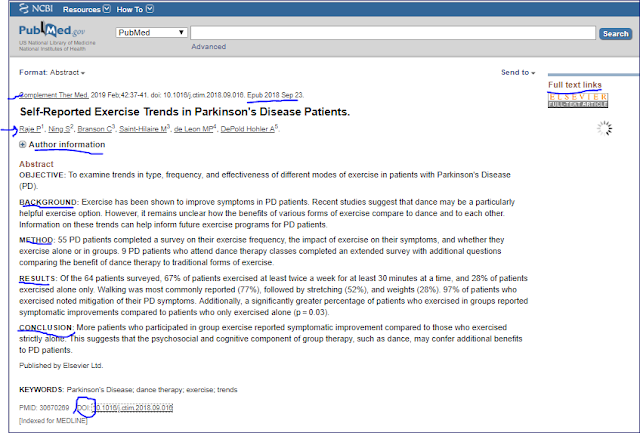
Here's an example of a recent abstract that has been marked to help you identify useful information:
Here are a few things that I do:
Read the Conclusion first (not all abstracts contain these helpful headers, but at least the conclusion will be at the end). This tells us that: "More patients who participated in group exercise reported symptomatic improvement compared to those who exercised strictly alone..." Hm, so pwp are doing better in group exercise.
If I want to know more, I move up to Results. This tells me some statistics (which I understand some of the time), and more details than the Conclusion. For instance, 97% of those who exercised improved their symptoms.
How was the study done? How many were involved? For this, I move up to Method / Methods. This tells me and number of patients or healthy people were studied, and what action was taken; in this case, it was a survey.
Background will tell briefly about the reasoning or earlier research that lead to this study.
Up at the top are the title and the authors; if I want to know more about who did the research, I can click on + Author Information (in Pubmed, not in the illustration). At the top is also the journal name and the publication date; often there is an Epub date, date published online, that may be earlier than the "official" publication date. This tells me how recently the work was done.
Often this is enough, but sometimes I want to know more. For instance, how old were the subjects, or what mix of genders. Maybe I want to know more about the methodology that was used. In that case, I need to read the full paper; sometimes I can reach it, either by clicking on Full Text Links (upper right) or on the DOI number (lower left). Since I've had better luck with the DOI number (Digital Object Identifier), if the Full Text Link doesn't say "Free," I click on DOI. Sometimes all that I can find there is the abstract, but sometimes, with some publishers, there is more. Some publishers include Highlights, the essential findings, which can be more useful than the abstract for telling about key findings:
Sometimes I can see the full paper, as in this case; the abstract is at the beginning of the paper, and then the full paper follows.
If I want more, the Discussion section of the full paper often has some of the most interesting material; it's here that researchers often compare their findings to those of different researchers, or reflect on what their results mean.
Sometimes the full paper is behind a Paywall; that means I need to be a subscriber to the journal or a medical/scientific database of these articles, or be willing to pay around $35 to read the paper - which I'm not. If you think you'll routinely want to read whole papers, cultivate a friend or family member who has access to these articles for their work, perhaps somebody in the scientific or medical field.
I'll be explaining how to evaluate a paper in a future blog post. For now, post a comment if you have a question, so that I can reply.
I spend a lot of time on Pubmed.gov, because most research is available there. (Google Scholar includes little of the research, so I avoid it.) What's available here are abstracts (summaries) of research, and sometimes links to the full articles.
Here's an example of a recent abstract that has been marked to help you identify useful information:
Here are a few things that I do:
Read the Conclusion first (not all abstracts contain these helpful headers, but at least the conclusion will be at the end). This tells us that: "More patients who participated in group exercise reported symptomatic improvement compared to those who exercised strictly alone..." Hm, so pwp are doing better in group exercise.
If I want to know more, I move up to Results. This tells me some statistics (which I understand some of the time), and more details than the Conclusion. For instance, 97% of those who exercised improved their symptoms.
How was the study done? How many were involved? For this, I move up to Method / Methods. This tells me and number of patients or healthy people were studied, and what action was taken; in this case, it was a survey.
Background will tell briefly about the reasoning or earlier research that lead to this study.
Up at the top are the title and the authors; if I want to know more about who did the research, I can click on + Author Information (in Pubmed, not in the illustration). At the top is also the journal name and the publication date; often there is an Epub date, date published online, that may be earlier than the "official" publication date. This tells me how recently the work was done.
Often this is enough, but sometimes I want to know more. For instance, how old were the subjects, or what mix of genders. Maybe I want to know more about the methodology that was used. In that case, I need to read the full paper; sometimes I can reach it, either by clicking on Full Text Links (upper right) or on the DOI number (lower left). Since I've had better luck with the DOI number (Digital Object Identifier), if the Full Text Link doesn't say "Free," I click on DOI. Sometimes all that I can find there is the abstract, but sometimes, with some publishers, there is more. Some publishers include Highlights, the essential findings, which can be more useful than the abstract for telling about key findings:
Sometimes I can see the full paper, as in this case; the abstract is at the beginning of the paper, and then the full paper follows.
If I want more, the Discussion section of the full paper often has some of the most interesting material; it's here that researchers often compare their findings to those of different researchers, or reflect on what their results mean.
Sometimes the full paper is behind a Paywall; that means I need to be a subscriber to the journal or a medical/scientific database of these articles, or be willing to pay around $35 to read the paper - which I'm not. If you think you'll routinely want to read whole papers, cultivate a friend or family member who has access to these articles for their work, perhaps somebody in the scientific or medical field.
I'll be explaining how to evaluate a paper in a future blog post. For now, post a comment if you have a question, so that I can reply.
Friday, May 3, 2019
What I wish I had known... being first diagnosed with PD
It was December 20, 2016. It was like a bomb went off close by, so I couldn't hear anything for awhile. My neurologist had made sure it wasn't MS/stroke/Lyme/vitamin deficiency and a host of other things that look like Parkinson's, but aren't. I was pretty sure he was going to say I had PD - after all, my mom and her brother both had it, and I knew something was very wrong.
But hearing the diagnosis confirmed... I didn't hear anything for awhile. Fortunately, my husband and daughter were both there to listen.
I read a lot then, but not everything soaked in, because in the background my mind was shouting, OMG OMG OMG OMG OMG...
What I wish I had known immediately, because it would have helped me focus on living (and might have helped my family, too):
Exercise is critical - not only will it help you feel better, but if vigorous enough, it seems to slow progression and improve symptoms. Fortunately, I already had an exercise habit at dx (diagnosis). For more.
Find other pwp. They provide support, they understand, and they have resources. Support group, online forums, PD exercise group - all places to find your new peers. Set aside your assumptions about age, or gender. You have a lot in common.
Watch out for snake oil as well as for the over-enthusiastic press. There are people who want to make a buck out of your worry. See here and here and here and here and here. And the press will report that there is a cure - but it turns out the hopeful results were in ... mice. It's important to find valid sources for information - talk show hosts, internet advertisements, and your brother-in-law's cousin's buddy are not it. I heartily recommend The Science of Parkinson's.
Alternative / complementary medicine has not been found to cure PD, but it can help make you more comfortable. So. Why. Not?
Find a movement disorder specialist - a neurologist who has extra training and experience with PD. You may see your primary care doctor or your neurologist more often, but a MDS can make a huge difference in diagnosis and care. And be sure you can phone/email/patient portal when you have questions or concerns; getting your medications/dosage right or dealing with an alarming new symptom are not matters to wait for the next appointment in weeks or months. In the US, you can use https://parkinson.org/Living-with-Parkinsons/in-your-area. Or email your location to info@movementdisorders.org.
Be proactive. I am not sorry that I found a good physical therapist who is experienced with PD. Or that I found a good speech therapist. And saw them when my problems were minor. Specialists like these can really help you now - don't wait until you can't get out of a chair, or you can't swallow or your voice is so quiet that nobody can hear you. They can give you exercises that will help you stay on top of symptoms before they get overwhelming. (I remember to do all those exercises by pairing them with an activity - like feeding the dog, or being in the car - that reminds me to do them.)
Read Every Victory Counts, published by the Davis Phinney Foundation. This includes the voices of pwp and their families, addresses complementary therapies, as well as more mainstream therapies. It is focused on living your best life now, and is much more helpful than many of the conventional books written by physicians. Available for free download and sometimes also in paper - free.
Recognize that this may be as hard for your family to grasp as it has been for you. Some will be in denial, telling you that It's all in your head. Sometimes because they don't deal with illness well. Sometimes because this shifts your roles - maybe you were the caregiver and that can't be any more. Some will have opinions about your choices for treatment, forgetting that these are your choices. While they are adjusting, being with other pwp is very helpful. Take family to a support group, too.
Live in the present, but plan for the future. Grab bars in the bathroom. Living will and other legal papers. Investigate the care you might need down the road. My mom needed, eventually, 24 hour care, because she could not stand or walk; not everybody reaches that point, but you may have to deal with it. And don't assume that your spouse can do everything - because even a few hours of physical care can be exhausting to provide.
If you're inclined to participate in finding better therapies, then explore being part of a clinical trial - a scientific study to find out more about possible PD treatments.
Focus on what you CAN do. At the start, PD will remind you of what's hard to do, and you will have this loud volume reminder (OMG I have PD), but if you are wise, in time you just move on to what IS. This is not passive resignation, it is facing reality but living your best life anyway. Michael J. Fox provides a great example of this (but so do many, many others).
This one is hard: accept help. And even harder: ask for help. Getting my cane was a revelation; so many strangers held doors for me. I don't always need it, but that handicapped parking sticker is a Godsend when I do. Exhaustion does not make PD better. People really do like to help.
But hearing the diagnosis confirmed... I didn't hear anything for awhile. Fortunately, my husband and daughter were both there to listen.
I read a lot then, but not everything soaked in, because in the background my mind was shouting, OMG OMG OMG OMG OMG...
What I wish I had known immediately, because it would have helped me focus on living (and might have helped my family, too):
Exercise is critical - not only will it help you feel better, but if vigorous enough, it seems to slow progression and improve symptoms. Fortunately, I already had an exercise habit at dx (diagnosis). For more.
Find other pwp. They provide support, they understand, and they have resources. Support group, online forums, PD exercise group - all places to find your new peers. Set aside your assumptions about age, or gender. You have a lot in common.
Watch out for snake oil as well as for the over-enthusiastic press. There are people who want to make a buck out of your worry. See here and here and here and here and here. And the press will report that there is a cure - but it turns out the hopeful results were in ... mice. It's important to find valid sources for information - talk show hosts, internet advertisements, and your brother-in-law's cousin's buddy are not it. I heartily recommend The Science of Parkinson's.
Alternative / complementary medicine has not been found to cure PD, but it can help make you more comfortable. So. Why. Not?
Find a movement disorder specialist - a neurologist who has extra training and experience with PD. You may see your primary care doctor or your neurologist more often, but a MDS can make a huge difference in diagnosis and care. And be sure you can phone/email/patient portal when you have questions or concerns; getting your medications/dosage right or dealing with an alarming new symptom are not matters to wait for the next appointment in weeks or months. In the US, you can use https://parkinson.org/Living-with-Parkinsons/in-your-area. Or email your location to info@movementdisorders.org.
Be proactive. I am not sorry that I found a good physical therapist who is experienced with PD. Or that I found a good speech therapist. And saw them when my problems were minor. Specialists like these can really help you now - don't wait until you can't get out of a chair, or you can't swallow or your voice is so quiet that nobody can hear you. They can give you exercises that will help you stay on top of symptoms before they get overwhelming. (I remember to do all those exercises by pairing them with an activity - like feeding the dog, or being in the car - that reminds me to do them.)
Read Every Victory Counts, published by the Davis Phinney Foundation. This includes the voices of pwp and their families, addresses complementary therapies, as well as more mainstream therapies. It is focused on living your best life now, and is much more helpful than many of the conventional books written by physicians. Available for free download and sometimes also in paper - free.
Recognize that this may be as hard for your family to grasp as it has been for you. Some will be in denial, telling you that It's all in your head. Sometimes because they don't deal with illness well. Sometimes because this shifts your roles - maybe you were the caregiver and that can't be any more. Some will have opinions about your choices for treatment, forgetting that these are your choices. While they are adjusting, being with other pwp is very helpful. Take family to a support group, too.
Live in the present, but plan for the future. Grab bars in the bathroom. Living will and other legal papers. Investigate the care you might need down the road. My mom needed, eventually, 24 hour care, because she could not stand or walk; not everybody reaches that point, but you may have to deal with it. And don't assume that your spouse can do everything - because even a few hours of physical care can be exhausting to provide.
If you're inclined to participate in finding better therapies, then explore being part of a clinical trial - a scientific study to find out more about possible PD treatments.
Focus on what you CAN do. At the start, PD will remind you of what's hard to do, and you will have this loud volume reminder (OMG I have PD), but if you are wise, in time you just move on to what IS. This is not passive resignation, it is facing reality but living your best life anyway. Michael J. Fox provides a great example of this (but so do many, many others).
This one is hard: accept help. And even harder: ask for help. Getting my cane was a revelation; so many strangers held doors for me. I don't always need it, but that handicapped parking sticker is a Godsend when I do. Exhaustion does not make PD better. People really do like to help.
Tuesday, April 30, 2019
Can red light help?
Recently, my husband made me a bucket like a hat filled with red lights and with infrared lights that shine on my head.
I wear this twice a day for 20 minutes. Why?
Well, there is some research that seems to show that red and near infrared light helps neurological conditions. And there are active clinical trials in Australia (article about it), (here's the link to the actual trial) and elsewhere related to Parkinson's and this kind of light. This paper talks a bit about how they made a helmet.
My husband used red lights and infrared lights inside, there's padding on top, and a buckle with wide elastic so that it stays on straight. It's easy to pull the wires out by accident (ask me how I know), so I plug in the bucket (it plugs into a computer power supply) and then put it on. After 20 minutes, I take it off, then unplug. Though you can't see it, he etched giant glasses just like I wear on the front, and hair on the back. The pictures help me keep track of the front. Here you can see what it looks like when lit.
Even with holes drilled towards the top, it still gets a bit warm, which feels good in cool weather.
Does this have an impact? We'll see. Since I started a curcumen supplement at around the same time, and I've been slowly increasing the time that I spend on Qigong, it is getting hard to say what works. But this bucket certainly makes me feel loved.
I wear this twice a day for 20 minutes. Why?
Well, there is some research that seems to show that red and near infrared light helps neurological conditions. And there are active clinical trials in Australia (article about it), (here's the link to the actual trial) and elsewhere related to Parkinson's and this kind of light. This paper talks a bit about how they made a helmet.
My husband used red lights and infrared lights inside, there's padding on top, and a buckle with wide elastic so that it stays on straight. It's easy to pull the wires out by accident (ask me how I know), so I plug in the bucket (it plugs into a computer power supply) and then put it on. After 20 minutes, I take it off, then unplug. Though you can't see it, he etched giant glasses just like I wear on the front, and hair on the back. The pictures help me keep track of the front. Here you can see what it looks like when lit.
Even with holes drilled towards the top, it still gets a bit warm, which feels good in cool weather.
Does this have an impact? We'll see. Since I started a curcumen supplement at around the same time, and I've been slowly increasing the time that I spend on Qigong, it is getting hard to say what works. But this bucket certainly makes me feel loved.
Thursday, April 18, 2019
Textured insoles for balance? Will these improve my PD?
A few months ago, I read about textured insoles that are supposed to help you be more aware of your proprioception (your sense of where your extremities are and how they're moving), and thus improve your gait (how you walk) and your balance. They're a bit pricey ($50), but I'm open to trying out what might help, so I ordered some. You can cut them to precisely fit your feet. http://nabosotechnology.com/proprioceptiveinsoles
I wore them sometimes to Physical Therapy where I walk a lot and really get put through my paces, and around the house. For weeks. They seem to help me take a sharp corner (going around furniture at home). Otherwise, I haven't seen a benefit.
What does the research say? A meta-analysis published in early 2017 found that:
"Textured/Stimulating insoles had no significant effects on variables of gait and balance,"
and the quality of the studies available was inadequate. (A meta-analysis reviews available research studies, evaluates how well the studies are done, and evaluates what the studies show.) I've read many studies of these insoles that said, basically, textured insoles seem to help, or it's possible they help. (I believe the expression is, Damned by faint praise.) At the same time, the studies had few research subjects and similar problems. So I guess I am not too surprised by this meta-analysis, which I discovered after I purchased the insoles: https://www.sciencedirect.com/science/article/pii/S0966636216306099
I wore the insoles, increasing the time gradually, as they kind of poke into your feet. Weeks later, I was still feeling poked, which I guess they are supposed to do. But did they lengthen my stride? No. Did they improve my balance? No. Did they improve my gait? At all? No.
Now, I've seen videos that seem to show miraculous improvements from using these insoles - a woman barely able to walk starts to wear these insoles and then is able to run. Too good to be true? I doubted I'd see a miracle in my own case because the research studies were underwhelming. I hoped I'd see some improvement. But all I have is sore feet.
Images from the websites above.
I wore them sometimes to Physical Therapy where I walk a lot and really get put through my paces, and around the house. For weeks. They seem to help me take a sharp corner (going around furniture at home). Otherwise, I haven't seen a benefit.
What does the research say? A meta-analysis published in early 2017 found that:
"Textured/Stimulating insoles had no significant effects on variables of gait and balance,"
and the quality of the studies available was inadequate. (A meta-analysis reviews available research studies, evaluates how well the studies are done, and evaluates what the studies show.) I've read many studies of these insoles that said, basically, textured insoles seem to help, or it's possible they help. (I believe the expression is, Damned by faint praise.) At the same time, the studies had few research subjects and similar problems. So I guess I am not too surprised by this meta-analysis, which I discovered after I purchased the insoles: https://www.sciencedirect.com/science/article/pii/S0966636216306099
I wore the insoles, increasing the time gradually, as they kind of poke into your feet. Weeks later, I was still feeling poked, which I guess they are supposed to do. But did they lengthen my stride? No. Did they improve my balance? No. Did they improve my gait? At all? No.
Now, I've seen videos that seem to show miraculous improvements from using these insoles - a woman barely able to walk starts to wear these insoles and then is able to run. Too good to be true? I doubted I'd see a miracle in my own case because the research studies were underwhelming. I hoped I'd see some improvement. But all I have is sore feet.
Images from the websites above.
Saturday, April 13, 2019
What I'm trying now... Qigong
I've been exploring Qigong (chi-GUNG), which is related to Tai Chi, and which I've learned about from my Tai Chi teacher. Since my teacher has been ill, I've been pursuing this on my own, via books and online courses, as well as continuing what I learned in class.
This exploration lead me to Bianca Molle, who seems to have beat back PD by spending three hours a day doing Qigong; she used DVDs from Mington Gu who now has online courses at The Chi Center. I took his online class for some time, but, frankly, it moved too slowly for me after awhile.
Then I looked into what Bruce Frantzis has to offer, as he has some really well-thought of books and courses. I have been reading his book about Dragon and Tiger Qigong (which is Qigong specially designed for healing). I learn physical things by watching and following along, so I have been taking an online course from one of his students, Bill Ryan; this has been enormously helpful for helping me learn the Dragon and Tiger form, combined with the book. Also recently have returned to Dr. Paul Lam's DVD/download Tai Chi classes. While the Qigong leaves me feeling refreshed, it doesn't do much to challenge my balance, and the Tai Chi provides that.
Right now, I spend 30-45 minutes a day working on my practice. Practice has multiple meanings, including - to repetitively work on something to get better at it.
The Davis Finney Foundation funded research that evaluated many existing studies (called a meta-study) and found that Tai Chi and Qigong do help PD symptoms.
I've been doing a variety of Qigong practices for about 6 months. I've noticed an improvement in non-motor symptoms: urinary urge is less, sleeping better (able to return to sleep more quickly), small motor skills like typing and writing have improved a little. Dry eyes are a bit better, too. Cognition is a bit better - less problems with word-finding (long may that last). On the other hand, rigidity and slowness are the same, as is blood pressure (too low). The one thing that's not getting better that I really want to improve, still, is balance - trouble with stairs and curbs, lurching like a drunk. Grrrrrr. Still, there are brief times (under a minute) when my walking is normal, which hasn't ever happened, so I'm keeping an eye on this.
Lam and Frantzis images from Amazon.
This exploration lead me to Bianca Molle, who seems to have beat back PD by spending three hours a day doing Qigong; she used DVDs from Mington Gu who now has online courses at The Chi Center. I took his online class for some time, but, frankly, it moved too slowly for me after awhile.
Then I looked into what Bruce Frantzis has to offer, as he has some really well-thought of books and courses. I have been reading his book about Dragon and Tiger Qigong (which is Qigong specially designed for healing). I learn physical things by watching and following along, so I have been taking an online course from one of his students, Bill Ryan; this has been enormously helpful for helping me learn the Dragon and Tiger form, combined with the book. Also recently have returned to Dr. Paul Lam's DVD/download Tai Chi classes. While the Qigong leaves me feeling refreshed, it doesn't do much to challenge my balance, and the Tai Chi provides that.
Right now, I spend 30-45 minutes a day working on my practice. Practice has multiple meanings, including - to repetitively work on something to get better at it.
I've been doing a variety of Qigong practices for about 6 months. I've noticed an improvement in non-motor symptoms: urinary urge is less, sleeping better (able to return to sleep more quickly), small motor skills like typing and writing have improved a little. Dry eyes are a bit better, too. Cognition is a bit better - less problems with word-finding (long may that last). On the other hand, rigidity and slowness are the same, as is blood pressure (too low). The one thing that's not getting better that I really want to improve, still, is balance - trouble with stairs and curbs, lurching like a drunk. Grrrrrr. Still, there are brief times (under a minute) when my walking is normal, which hasn't ever happened, so I'm keeping an eye on this.
Lam and Frantzis images from Amazon.
Sunday, March 3, 2019
What's wrong with clinical trial process? A participant's perspective
I really want researchers to find ways to slow or reverse progression of the disease, and to find ways to make the many symptoms less bothersome (insomnia, urinary incontinence, lack of appetite...) So I'm motivated to participate in research (which means clinical trials - see this article for more information).
In sum, besides the almost standard desire for less than 2 years from diagnosis and drug naive, which is a tiny subset of PD patients, there seems to be a willingness to inconvenience the patients (and their families), casually put them in danger, and generally use them and then spit them out.
Pwp who have been through the actual trial process on potential drugs are equally frustrated by disorganized researchers, being cut off from a treatment that helped their condition improve because the trial is over, and then never being told the results of the study - and since 40% of trials NEVER publish their findings, they might never know. Some of these pwp don't want to be used again, and can you blame them? (See some of Christopher Maycock's excellent thinking on this topic.)
What could attract me, and other pwp, to clinical trials?
| From PDTrialTracker.Info |
Here's what has happened when I tried to sign up for clinical trials:
- When I was first diagnosed, and not taking any meds yet, I contacted the local research center who said... Oh, we're not doing any studies on PD now. They could not have sounded more bored. And though I left email, phone, address, they have not contacted me. Not once. In two years.
- I called a trial in a neighboring state, but they wanted me to go there once a month for a year. This means my husband would have to drive me at least 12 times, as I can't drive that far any more. (A train takes longer, and unexpectedly requires climbing up or down steps - not remotely disabled-friendly.)
- When I looked for trials anywhere within driving distance recently, the only trial I could participate in was a 3 hour drive one-way, and required repeated visits. Not near public transport - and in the middle of nowhere. Um, who is going to go there?
- I was looking through trials, and one looked possible, until I noticed that, not only do they want monthly visits, they want to do a lumbar puncture at each visit (that's a puncture of the spine to get spinal fluid). That means, at the very least, a blinding headache. I have to ask the clinicians who dreamed this up: would you be willing to have this procedure performed on you once a month?
- Tried to enroll in a study about tracking PD symptoms on a Smartphone - twice. Once was a Samsung phone; one an iPhone. I had problems with the software on both phones. Emailed the contact person - in one case, after instructing me to re-install the software, the response was, I guess it doesn't work with your phone. With the other phone, never got an answer.
- Clinicians had come to a local conference of pwp looking for participants in their trial. It sounded intriguing, and didn't involve any dangerous testing. When I was screened by the clinician later, because I have atypical Parkinsonism (no tremor, but balance issues), she suddenly wasn't interested. Well, if you're still doing well in a year, give me a call; if we're having trouble getting participants then we can include you. That was welcoming.
- A guy in a suburb of a major city emails me about his trial - 6 hour drive one way - but he thinks I should participate, and be happy to go there monthly. His tested treatment happens to be known to make another medical condition that I have worse. so I wouldn't consider it; he is sure it's not a big deal and is perfectly willing to risk my health for his trial. Update: When I looked up this trial, it wasn't recorded on ClinicalTrials .gov, although it probably should be, by US law. So who is looking out for the human beings in this trial?
- I've registered on Fox Trial Finder, as well as several other "I'm interested in participating" websites. Do I ever hear from any of them about new trials? Rarely to never.
- I do hear from one company that does clinical trial work for large pharmaceutical companies. What they call me about: Phase 1 trials of some unknown compound; this is a study to find out if the compound is even safe to use. They seem uncomfortable when I ask the question, "Is this a Phase 1 or Phase 2 trial?" Scientists do Phase 1 trials on a small number of patients, so if it's dangerous, not too many are harmed. And did I mention that any resulting harm to my health is entirely my problem? Oh, and it requires a lengthy drive once a week for as long as the trial goes on (which my husband would have to do). Sounds appealing, no?
In sum, besides the almost standard desire for less than 2 years from diagnosis and drug naive, which is a tiny subset of PD patients, there seems to be a willingness to inconvenience the patients (and their families), casually put them in danger, and generally use them and then spit them out.
Pwp who have been through the actual trial process on potential drugs are equally frustrated by disorganized researchers, being cut off from a treatment that helped their condition improve because the trial is over, and then never being told the results of the study - and since 40% of trials NEVER publish their findings, they might never know. Some of these pwp don't want to be used again, and can you blame them? (See some of Christopher Maycock's excellent thinking on this topic.)
What could attract me, and other pwp, to clinical trials?
- Being treated like a valued customer, not a used kleenex.
- Recognition that my participation involves inconvenience and possible exhaustion. Telemedicine, anyone?
- Treat me like an interested partner - I might have insights that could help you reduce the barriers that are making recruitment hard, as well as insights about what success in the trial would mean to me, the PD patient.
- Look to include many different kinds of pwp because you don't know which group of us will be helped by your drug/procedure/device.
- Recognize that I might be risking my health - and plan for that eventuality with insurance (I should not be out of pocket if I'm harmed).
- Tell me about your results and what the next steps are. For example, can I be involved in the next wave of testing?
- Provide my physician with all test results and what I was dosed with.
I don't think any of this is too much to ask. To their credit, there are researchers that do a lot of this. Why don't all researchers do this?
Sunday, February 17, 2019
Suppose I want to know the results of a Clinical Trial?
Here’s an ugly truth – even though Clinical Trials need pwp
(and sometimes people without Parkinson’s), about 40% of these studies never publish
their findings* (this is true for all research there, not just for PD). Note that NIH and Michael J.
Fox Foundation, among others, make publication of results a requirement of
funding; wish all funders had such a requirement.
Fortunately, there are several ways to find out the
results. First, make sure the study has
finished. Instead of the status of
Recruiting, it will be Completed in ClinicalTrials.gov. (See this article for more information about using ClinicalTrials.gov.)
In all
cases, you’ll search in Pubmed.gov,
a database of biomedical journal research articles from the US and the
international research community. Usually
a summary (called an abstract) of the article is available, with a link to the
entire article; sometimes the article itself is
free, but sometimes it’s behind a paywall (meaning you must pay the journal to
see the article).
You can search Pubmed with keywords, just like Google. Why not just use Google? Because Google will give you many confusing records you'll need to weed through; Pubmed is easier For a lot more about usingPubmed, see this article.
1. The easiest way to look for a possible journal article is
to search for the NCT number (National Clinical Trial) on the Pubmed.gov database, since some researchers refer to the NCT number in their papers. Just enter the NCT number (found throughout the
ClinicalTrial.gov record) into the search field at Pubmed.gov as in the example above.
Here's an example of the start of an abstract that could result from such a search. You can see the link(s) to the full article on the right.
2 . Entering the NCT number didn’t work? Put
on your detective hat. From the Clinical
Trial record for this study, get the name of the Principal Investigator (scroll
down to the bottom of the Tab called Tabular View.) Then look for the title of the study (at the top); you may also have to read
the summary paragraph that explains what the study is about. From these, pull out what you think are the
important keywords – for example, name of drug or device or technique used.
In the Pubmed.gov database, in the search bar put the
keywords and the Principal Investigator’s name.
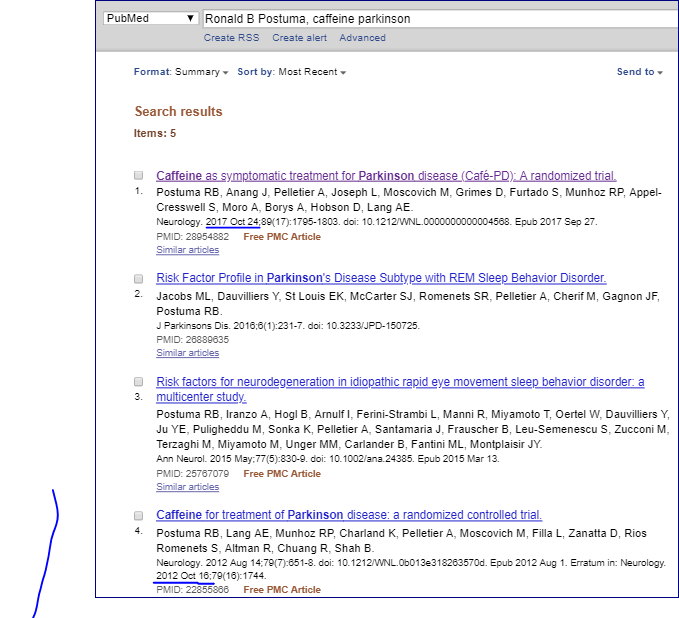
You may also need to add the term Parkinson. See the example below:
There may be nothing, or multiple
articles. If the title doesn’t tell you
enough to decide which is the right article, compare the Completion Date from ClinicalTrial.gov with the publication
date of the articles; the publication date is usually at or later than the
Completion Date; this was done in the example shown above, choosing the 2017 article because it comes a few months after completion.
3. If none of the papers deal with the clinical trial, there's one more place. Often you'll find an
email address associated with the Principal Investigator in the Clinical Trial
database, so you could email this person to ask about publication of results. There may be a paper that you didn’t find, or the paper may
be in the process of being published, so you don't want to assume they didn't publish. Here’s an example email: “I’ve been looking for the paper that
describes the results of NCT12345678. Title of Study. Can you help?” If they have a paper, they can
provide the link. If they don’t have a
paper, you may have managed to make them feel a bit embarrassed, all while
staying completely polite yourself, and not risking embarrassment. (Take the high road.)
4. By the way, if somebody gives you a DOI number (used in
electronic publishing), go to dx.doi.org,
enter the number in the search box, and you’ll go right to the summary and/or article. (Google will give you confusing choices.)
5. If none of these work, you've struck one of the 40%. Studies that use US government money are required to publish their results. Shouldn't funders from companies, foundations, and universities require the same?
*Wyant, Kara J., Yasuda, Erica, Kotagal, Vikas. “The 10‐Year Landscape of United States‐Registered Parkinson Disease Clinical Trials: 2007–2016.” Movement Disorders, Wiley InterScience, 4 Oct. 2018, onlinelibrary.wiley.com/doi/abs/10.1002/mdc3.12665.
Monday, March 5, 2018
Feelings about finding "the cure"
Since my mom was diagnosed with PD about 30 years ago, I've been hearing "the cure is right around the corner" for a long time. Turns out that it's hard to know what causes PD, so the "cure" is more elusive.
But I keep track of lots of PD research, so I know just how broadly the research is done, and how worldwide it is. We know now that PD can have a genetic component; at the time, Mom and her brother both having PD was just an accident, or maybe something in their environment. Besides that, nobody knew then that vigorous exercise could have such a profound effect on the disease.
Like many of us, I scour forums and research reports for tantalizing possibilities, but more for what slows progression and what makes life easier right now - because that's where I live, in the now.
One gift that PD has given me is the ability to live today, to not waste time on the past, and not to worry about the future. Yes, I've looked into the paperwork for a personal health care representative, and I know what extreme treatments I don't want, and when I am going to say, definitely DNR (Do Not Resuscitate). Yes, I know that with all the exercise, I am still likely to get worse. If there is a treatment that works for me - great! But right now, I am enjoying that I can cook, read, weave, teach, enjoy the outdoors.
In terms of that elusive "cure," maybe I've become Scarlett O'Hara and, "I'll think about that tomorrow."
One gift that PD has given me is the ability to live today, to not waste time on the past, and not to worry about the future. Yes, I've looked into the paperwork for a personal health care representative, and I know what extreme treatments I don't want, and when I am going to say, definitely DNR (Do Not Resuscitate). Yes, I know that with all the exercise, I am still likely to get worse. If there is a treatment that works for me - great! But right now, I am enjoying that I can cook, read, weave, teach, enjoy the outdoors.
In terms of that elusive "cure," maybe I've become Scarlett O'Hara and, "I'll think about that tomorrow."
Monday, January 22, 2018
Stem Cell treatment for PD
A word about stem cell clinical trials. Here’s a research update on stem cells, one of many promising avenues in PD research: https://www.michaeljfox.org/foundation/news-detail.php?stem-cells-safe-in-pre-clinical-parkinson-disease-study I’ll quote from the update, dated August, 2017: Currently, there are no approved or accepted stem cell treatments for Parkinson's disease, and so, The Michael J. Fox Foundation urges people with PD to view so-called clinics offering stem cell therapies for PD with 'buyer beware' skepticism.
There are new stem cell study results related to PD coming out all the time, but almost all are in petri dishes or in animals.
That means if somebody is promising treatment using stem cells, you should look at their claims long and hard. If they say it is a clinical trial, but then want you to pay big bucks, then you need to ask a whole lot of questions, and probably want to grab your wallet and run. Genuine clinical trials don’t cost you anything.
I looked up stem cell research trials on ClinicalTrial.gov. Legitimate stem cell research is still carefully trying to see if the therapy is effective – and safe. For example, studies at major medical centers use only 4 or 12 patients to check for safety of stem cell therapy – they want to risk as few people as possible. So why would a non-university center take any warm body older than 16 (yes – age 16), for doing a “study” of 3,000 patients. The non-university (read for-profit) center has a very interesting page on their website: ... [We] are not offering stem cell therapy as a cure for any condition, disease, or injury. No statements or implied treatments on this website have been evaluated or approved by the FDA. They want your money, but what they are offering is not a cure. Hmmm.
Further, the for-profit clinic is offering patient funded research. In a real clinical trial, treatment costs nothing for the people who participate. Like I said: You probably want to run. Legit studies are still finding out of the treatment is safe.
Remember that inclusion in the government clinical trial database does not mean it’s been okayed by the government. In fact, Clinical Trials.gov states: Listing a study on this site does not mean it has been evaluated by the U.S. Federal Government. The safety and scientific validity of a study listed on ClinicalTrials.gov is the responsibility of the study sponsor and investigators.
This just in: the FDA has issued a Warning Letter to American CryoStem, the manufacturer of stem cells used by for-profit clinics to "treat" PD and other conditions. The FDA said these stem cells are a drug being marketed without benefit of FDA approval. Further - and this is really scary - the FDA found "evidence of significant deviations from current good manufacturing practice requirements... such as potentially being contaminated with microorganisms or having other serious product quality defects. Specific deviations included unvalidated processes, an inadequately controlled environment, lack of control of components used in production, and a lack of sufficient and validated product testing." So the company isn't checking thoroughly to make sure the cells aren't contaminated, among many other basic controls. These are cells that the clinics want to put in your brain. For further information, see: https://www.fda.gov/NewsEvents/Newsroom/PressAnnouncements/ucm591371.htm
Stem cells might be wonderful, and some very gifted researchers are working hard to find out how stem cells work, how stem cells can be used to treat PD, and if they are safe. But our wanting this to be the answer doesn't make it the answer.
God knows that we want a magic pill but the closest thing we have so far is exercise.
Image from Pixabay.
There are new stem cell study results related to PD coming out all the time, but almost all are in petri dishes or in animals.
That means if somebody is promising treatment using stem cells, you should look at their claims long and hard. If they say it is a clinical trial, but then want you to pay big bucks, then you need to ask a whole lot of questions, and probably want to grab your wallet and run. Genuine clinical trials don’t cost you anything.
I looked up stem cell research trials on ClinicalTrial.gov. Legitimate stem cell research is still carefully trying to see if the therapy is effective – and safe. For example, studies at major medical centers use only 4 or 12 patients to check for safety of stem cell therapy – they want to risk as few people as possible. So why would a non-university center take any warm body older than 16 (yes – age 16), for doing a “study” of 3,000 patients. The non-university (read for-profit) center has a very interesting page on their website: ... [We] are not offering stem cell therapy as a cure for any condition, disease, or injury. No statements or implied treatments on this website have been evaluated or approved by the FDA. They want your money, but what they are offering is not a cure. Hmmm.
Further, the for-profit clinic is offering patient funded research. In a real clinical trial, treatment costs nothing for the people who participate. Like I said: You probably want to run. Legit studies are still finding out of the treatment is safe.
Remember that inclusion in the government clinical trial database does not mean it’s been okayed by the government. In fact, Clinical Trials.gov states: Listing a study on this site does not mean it has been evaluated by the U.S. Federal Government. The safety and scientific validity of a study listed on ClinicalTrials.gov is the responsibility of the study sponsor and investigators.
This just in: the FDA has issued a Warning Letter to American CryoStem, the manufacturer of stem cells used by for-profit clinics to "treat" PD and other conditions. The FDA said these stem cells are a drug being marketed without benefit of FDA approval. Further - and this is really scary - the FDA found "evidence of significant deviations from current good manufacturing practice requirements... such as potentially being contaminated with microorganisms or having other serious product quality defects. Specific deviations included unvalidated processes, an inadequately controlled environment, lack of control of components used in production, and a lack of sufficient and validated product testing." So the company isn't checking thoroughly to make sure the cells aren't contaminated, among many other basic controls. These are cells that the clinics want to put in your brain. For further information, see: https://www.fda.gov/NewsEvents/Newsroom/PressAnnouncements/ucm591371.htm
Stem cells might be wonderful, and some very gifted researchers are working hard to find out how stem cells work, how stem cells can be used to treat PD, and if they are safe. But our wanting this to be the answer doesn't make it the answer.
God knows that we want a magic pill but the closest thing we have so far is exercise.
Image from Pixabay.
Monday, December 25, 2017
Using PubMed to find out more about PD Research
This post was updated at: http://parkiesupport.blogspot.com/2019/12/using-new-pubmed.html since there is a newer version of PubMed.
If you are curious about a particular topic, the US government maintains a free database of medical research articles, called PubMed.
You can search on a topic and it will give
you basic information about published medical research papers (title of the
paper, journal it was published in, date published, author names), with the
most recent articles first. You want to
narrow your topic, because a search just on “parkinson’s disease” yields more
than 95,000 articles. If you narrow the
topic to something like “parkinson’s disease industrial exposure” the numbers are much
less, and you can quickly look through the titles to see if you want to read
about any studies.
If you click on the article title, it’s linked to the
abstract, a short description of the work and results.
From the abstract, there is sometimes a link
to the full paper. Sometimes the full
paper is free, but many times it’s not.
You
can email the abstract to yourself, and can email the list of papers, called a
summary, to yourself.
Some articles are in PubMed right at the publication date, whereas others are
not. If you'd heard about the research, but it's not in PubMed yet, try Googling the journal,
which may have the abstract available from their website.
The terminology can be dense, but the articles can be
interesting. Definitely useful for
answering the question, “What does the research say?” Helpful also when somebody is sure they know
that something is a sure “cure.”
Subscribe to:
Posts (Atom)
Great tools to use during the Pandemic
Some organizations have stepped up for pwp who have lost socialization, and usually exercise programs and support groups. Even for those ex...
-
Make your voice heard! Help identify gaps in knowledge and support among Parkinson’s caregivers. Caregivers are often spouses, partners...
-
On his videos, Lonnie Herman swears that he's got the cure for Parkinson's, cancer, interstitial cystitis, you name it. He uses...
-
Looked into Marty Hinz and his amino acid supplementation, as I look into just about anything that might make PD easier. I have to say ...