I've been using a "red hat" since mid-April, 2019, so roughly two months. (See article with rationale - it's based on science.) As it gets warm with the warmer weather, my lovely husband added a computer fan. I have been wearing it twice a day for 20 minutes.
Hasn't seemed to do anything, except that my balance didn't seem to get any worse; up until now, my balance has consistently, relentlessly gotten slowly worse. Then I wasn't able to wear my hat for a few days because it was getting hot, and my balance started to get worse again.
My lovely husband added a small laptop fan to the top of my "hat," which improves ventilation. I'm wearing my "red hat" religiously once again, and hoping that my balance doesn't worsen again. Is this scientific? I have not known what, if anything would improve, or at least not deteriorate further, so I've just continued to go about my life, and periodically check myself for symptoms. My expectations have been low, which has been useful to avoid the placebo effect, something that works particularly well with pwp. Having my balance stable would be delightful, since this is by far my worst and scariest symptom, so I'm crossing my fingers. Back to just using the hat and waiting to see.
For more about the "red hat", including how to make your own, see:
Red lights on the brain blog.
Well Photobiomodulation website
Image from https://redlightsonthebrain.blog/diy-transcranial-light-hat-eliza/.
Monday, June 24, 2019
Saturday, June 15, 2019
How to find local support, exercise, speech therapists, physical therapists, and clinical trials
Here is where doctors, patients, and care partners can find local resources easily and quickly:
To find a local PD support group, use Google. Enter support Parkinson's your-state-name (or your city name) You can also try at PMD Alliance, which is working to build a US-wide list: https://www.pmdalliance.org/resources/support-groups/)
To find local exercise PD .exercise groups, use Google. Enter exercise Parkinson's your-state-name.
If you live in Connecticut, information about support and exercise has already been compiled.
To find local physical therapists who have experience working with PD, click on the APTA website and enter first your zipcode, and then select Neurological.
To find local speech therapists who have experience working with PD, you can select people based on the program they have been trained in:
Finally, if you would like to find Clinical Trials in your local area, use the Clinical Trials website.
This is the basic search screen.
Here's an example of adding PD, "recruiting", your location, and how far you'd be willing to travel.
(For more information, read this short article.)
Magnifying glass image from Pixabay.
To find a local PD support group, use Google. Enter support Parkinson's your-state-name (or your city name) You can also try at PMD Alliance, which is working to build a US-wide list: https://www.pmdalliance.org/resources/support-groups/)
To find local exercise PD .exercise groups, use Google. Enter exercise Parkinson's your-state-name.
If you live in Connecticut, information about support and exercise has already been compiled.
To find local physical therapists who have experience working with PD, click on the APTA website and enter first your zipcode, and then select Neurological.
To find local speech therapists who have experience working with PD, you can select people based on the program they have been trained in:
Finally, if you would like to find Clinical Trials in your local area, use the Clinical Trials website.
This is the basic search screen.
Here's an example of adding PD, "recruiting", your location, and how far you'd be willing to travel.
(For more information, read this short article.)
Magnifying glass image from Pixabay.
Monday, June 10, 2019
What happens at a clinical trial screening?
I've found a whole group of webinars about clinical trials that I have found both interesting and informative. Presenters often include professionals who help run trials.This latest addresses what happens during a clinical trial screening - this is where the researchers find out if you meet their needs, and you find out more details so you can decide whether to commit to the trial.
The presenters point out that the screening often takes place in two phases - preliminary (often done by telephone), and in person. The preliminary phase lets both you - the person who might want to be in the clinical trial - and the researcher, get to know whether you would be a good "fit" for the study, and whether you want to commit to the requirements (go to x place on these dates, provide samples for lab testing and/or diagnostic tests like MRI, and so on). Remember that participation is voluntary, so you decide if you're committed, even if they want you. (No recourse if they don't want you, though.)
I've been through this preliminary phase a number of times; it's here that you find out what are the basic patient characteristics the researchers are looking for - and what they want to avoid. (It's also usually in the written description in ClinicalTrials.gov.) It's also a great time to find out how often you'd have to go to their location (am I willing to drive to another state once a month for six months, for example?) This sure beats travelling to a laboratory or office or clinic, only to find that this particular trial doesn't work with my schedule, or I don't quite fit their needs. (The middle of the video talks about typical tests for an asthma clinical trial, so you may want to skip that part.)
For example, I participated in a study that looked at telemedicine as a way to diagnose a condition; in that study, a medical student answered my questions and asked a series of his own questions. Then the principal investigator phoned with more detailed questions. When we both agreed I would be useful in the study, I "signed" consent forms online. The actual study was done via the internet using software similar to Skype on our computers.
Later, I had the chance to be in a drug trial; a professional associated with the study phoned me in response to my email asking for more information. I met the basic screening criteria, but the time and energy commitment would have been substantial; I would have had to get somebody to drive me 3 hours round trip, not once or twice, but monthly for a year, so that they could do lab tests and observe my progress, if any. I decided that it was too much driving over too long a period; she did not pressure me in any way. Participation is my choice, always.
I found other useful webinars about clinical trials on Antidote's website, as well, which reflect Antidote's desire to educate patients as they recruit them for trials. Antidote provides a searchable database of trials (presumably based on clinicaltrial.gov) for patients, and, for researchers, "accelerates your [researcher] clinical trials through best-in-class digital recruitment and patient engagement." You might want to take a look.
The presenters point out that the screening often takes place in two phases - preliminary (often done by telephone), and in person. The preliminary phase lets both you - the person who might want to be in the clinical trial - and the researcher, get to know whether you would be a good "fit" for the study, and whether you want to commit to the requirements (go to x place on these dates, provide samples for lab testing and/or diagnostic tests like MRI, and so on). Remember that participation is voluntary, so you decide if you're committed, even if they want you. (No recourse if they don't want you, though.)
I've been through this preliminary phase a number of times; it's here that you find out what are the basic patient characteristics the researchers are looking for - and what they want to avoid. (It's also usually in the written description in ClinicalTrials.gov.) It's also a great time to find out how often you'd have to go to their location (am I willing to drive to another state once a month for six months, for example?) This sure beats travelling to a laboratory or office or clinic, only to find that this particular trial doesn't work with my schedule, or I don't quite fit their needs. (The middle of the video talks about typical tests for an asthma clinical trial, so you may want to skip that part.)
For example, I participated in a study that looked at telemedicine as a way to diagnose a condition; in that study, a medical student answered my questions and asked a series of his own questions. Then the principal investigator phoned with more detailed questions. When we both agreed I would be useful in the study, I "signed" consent forms online. The actual study was done via the internet using software similar to Skype on our computers.
Later, I had the chance to be in a drug trial; a professional associated with the study phoned me in response to my email asking for more information. I met the basic screening criteria, but the time and energy commitment would have been substantial; I would have had to get somebody to drive me 3 hours round trip, not once or twice, but monthly for a year, so that they could do lab tests and observe my progress, if any. I decided that it was too much driving over too long a period; she did not pressure me in any way. Participation is my choice, always.
I found other useful webinars about clinical trials on Antidote's website, as well, which reflect Antidote's desire to educate patients as they recruit them for trials. Antidote provides a searchable database of trials (presumably based on clinicaltrial.gov) for patients, and, for researchers, "accelerates your [researcher] clinical trials through best-in-class digital recruitment and patient engagement." You might want to take a look.
Monday, June 3, 2019
How I evaluate a research abstract/report - Did researchers do a good job?
Earlier, I explained the basics of reading a research abstract. But I'm not a scientist, and many of the statistics are over my head. Despite that, there are still intelligent questions I can ask to determine if research results are valid. For example:
How many people were studied? In a Phase 1 trial, focused on safety, the number will often be very small, especially with a technique not previously tried on humans. (Remember, Phase 1 - safety, Phase 2 - effectiveness/does it work + safety (still with a relatively small group), Phase 3 - efficacy and possibly also dose + safety, Phase 4 - continuing evaluation after FDA approval.)
But not all research is a clinical trial that fits into one of the Phases; sometimes scientists are just observing, as was the case in the sample research abstract about an exercise survey used in an earlier blog post. Or the research is on cells or on animals. Or the research paper is a review of current research on a particular topic, or even a meta-study, where data from multiple earlier studies is evaluated in fresh ways. This means the format may not be the same as the description in the earlier blog post.
But getting back to the number of people studied, the results are more meaningful if the number of research subjects was 200, not 20 or 2.
Another related question is: did the researchers use flawed data? In a recent study, just using medical records, the records used were for people diagnosed with PD or with a parkinsonism - and who had an EEG in their record. Since most people with PD don't have EEGs done related to their care, few records included an EEG; this resulted in only 19 PD patients being part of the study; considering the diversity of pwp, drawing conclusions comparing only 19 PD patients with those with MSA (multiple system atrophy) and other parkinsonisms is clearly a problem. And it wasn't mentioned by these researchers.
I don't have the advanced statistical skills to evaluate statistics, but I have learned a few things:
For example, p < 0.05 means this is a meaningful number, not just the result of chance. (P here means probability.)
There are lots of common sense questions to ask, such as:
There are probably other questions you can think of, too. These sorts of questions arm you when reading research papers, and even those press reports that trumpet "cure for PD found."
How many people were studied? In a Phase 1 trial, focused on safety, the number will often be very small, especially with a technique not previously tried on humans. (Remember, Phase 1 - safety, Phase 2 - effectiveness/does it work + safety (still with a relatively small group), Phase 3 - efficacy and possibly also dose + safety, Phase 4 - continuing evaluation after FDA approval.)
But not all research is a clinical trial that fits into one of the Phases; sometimes scientists are just observing, as was the case in the sample research abstract about an exercise survey used in an earlier blog post. Or the research is on cells or on animals. Or the research paper is a review of current research on a particular topic, or even a meta-study, where data from multiple earlier studies is evaluated in fresh ways. This means the format may not be the same as the description in the earlier blog post.
But getting back to the number of people studied, the results are more meaningful if the number of research subjects was 200, not 20 or 2.
Another related question is: did the researchers use flawed data? In a recent study, just using medical records, the records used were for people diagnosed with PD or with a parkinsonism - and who had an EEG in their record. Since most people with PD don't have EEGs done related to their care, few records included an EEG; this resulted in only 19 PD patients being part of the study; considering the diversity of pwp, drawing conclusions comparing only 19 PD patients with those with MSA (multiple system atrophy) and other parkinsonisms is clearly a problem. And it wasn't mentioned by these researchers.
I don't have the advanced statistical skills to evaluate statistics, but I have learned a few things:
For example, p < 0.05 means this is a meaningful number, not just the result of chance. (P here means probability.)
There are lots of common sense questions to ask, such as:
- Is the age of research subjects appropriate? (In one seriously flawed paper, subjects ranged from ages 20 to 78.)
- Are subjects taking other medications? (In the previous example, the researchers were evaluating an herbal supplement, and included subjects who were also taking other unspecified herbal supplements at the same time.)
- Is their basic math accurate? (In the previous example the number of subjects was different in different parts of the paper, with no explanation).
- Was this research in humans, cells, rats/mice? What happens in mice and even in petri dishes doesn't always follow once it's moved to humans; in fact, studies in mice of potential drugs have not translated well at all.
- Do the researchers have a monetary interest that may bias them? Did the company/foundation funding the research restrict publication of results? (Who is funding the study? This information is often at the end of the full paper. Researchers are now required to identify conflicts of interest (at the end of the full paper), but this information may not be as obvious in earlier research, so you may need to evaluate it yourself (in the example above, some of the researchers are company owners).
- Is the mix of genders reasonable? (A paper from Iran had only male subjects, possibly for cultural reasons, but this arbitrary exclusion calls the results into question.)
- Have researchers excluded too many people, or not enough?
- What kinds of side effects were experienced?
- Do researchers have a control group, a group they can compare the experimental group against? A related question: Have they found a way to identify the placebo effect? Do researchers know who is taking the trial drug, for example; their observations can be colored by their expectations. Does the study find a way around this?
- Did researchers ask the right questions?
- Finally, have the results been replicated (in the case of new research, especially)? If the results can't be repeated by different researchers, the original study's result can be questioned.
There are probably other questions you can think of, too. These sorts of questions arm you when reading research papers, and even those press reports that trumpet "cure for PD found."
Monday, May 27, 2019
How I read a research abstract/report
Sometimes research reports are really full of jargon and hard to read. But I've found some tricks that help me understand them better. (Evaluating them will be in a separate blog post.)
I spend a lot of time on Pubmed.gov, because most research is available there. (Google Scholar includes little of the research, so I avoid it.) What's available here are abstracts (summaries) of research, and sometimes links to the full articles.
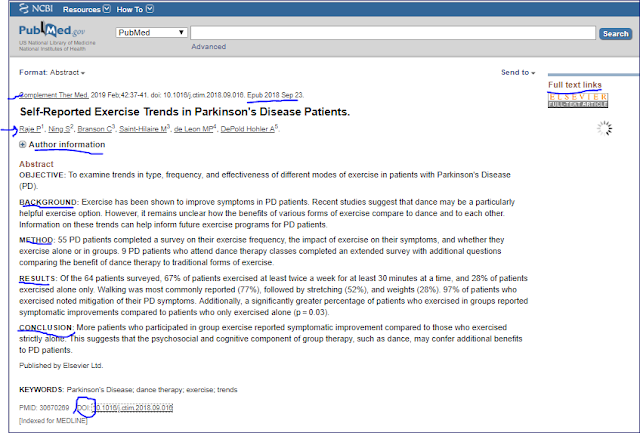
Here's an example of a recent abstract that has been marked to help you identify useful information:
Here are a few things that I do:
Read the Conclusion first (not all abstracts contain these helpful headers, but at least the conclusion will be at the end). This tells us that: "More patients who participated in group exercise reported symptomatic improvement compared to those who exercised strictly alone..." Hm, so pwp are doing better in group exercise.
If I want to know more, I move up to Results. This tells me some statistics (which I understand some of the time), and more details than the Conclusion. For instance, 97% of those who exercised improved their symptoms.
How was the study done? How many were involved? For this, I move up to Method / Methods. This tells me and number of patients or healthy people were studied, and what action was taken; in this case, it was a survey.
Background will tell briefly about the reasoning or earlier research that lead to this study.
Up at the top are the title and the authors; if I want to know more about who did the research, I can click on + Author Information (in Pubmed, not in the illustration). At the top is also the journal name and the publication date; often there is an Epub date, date published online, that may be earlier than the "official" publication date. This tells me how recently the work was done.
Often this is enough, but sometimes I want to know more. For instance, how old were the subjects, or what mix of genders. Maybe I want to know more about the methodology that was used. In that case, I need to read the full paper; sometimes I can reach it, either by clicking on Full Text Links (upper right) or on the DOI number (lower left). Since I've had better luck with the DOI number (Digital Object Identifier), if the Full Text Link doesn't say "Free," I click on DOI. Sometimes all that I can find there is the abstract, but sometimes, with some publishers, there is more. Some publishers include Highlights, the essential findings, which can be more useful than the abstract for telling about key findings:
Sometimes I can see the full paper, as in this case; the abstract is at the beginning of the paper, and then the full paper follows.
If I want more, the Discussion section of the full paper often has some of the most interesting material; it's here that researchers often compare their findings to those of different researchers, or reflect on what their results mean.
Sometimes the full paper is behind a Paywall; that means I need to be a subscriber to the journal or a medical/scientific database of these articles, or be willing to pay around $35 to read the paper - which I'm not. If you think you'll routinely want to read whole papers, cultivate a friend or family member who has access to these articles for their work, perhaps somebody in the scientific or medical field.
I'll be explaining how to evaluate a paper in a future blog post. For now, post a comment if you have a question, so that I can reply.
I spend a lot of time on Pubmed.gov, because most research is available there. (Google Scholar includes little of the research, so I avoid it.) What's available here are abstracts (summaries) of research, and sometimes links to the full articles.
Here's an example of a recent abstract that has been marked to help you identify useful information:
Here are a few things that I do:
Read the Conclusion first (not all abstracts contain these helpful headers, but at least the conclusion will be at the end). This tells us that: "More patients who participated in group exercise reported symptomatic improvement compared to those who exercised strictly alone..." Hm, so pwp are doing better in group exercise.
If I want to know more, I move up to Results. This tells me some statistics (which I understand some of the time), and more details than the Conclusion. For instance, 97% of those who exercised improved their symptoms.
How was the study done? How many were involved? For this, I move up to Method / Methods. This tells me and number of patients or healthy people were studied, and what action was taken; in this case, it was a survey.
Background will tell briefly about the reasoning or earlier research that lead to this study.
Up at the top are the title and the authors; if I want to know more about who did the research, I can click on + Author Information (in Pubmed, not in the illustration). At the top is also the journal name and the publication date; often there is an Epub date, date published online, that may be earlier than the "official" publication date. This tells me how recently the work was done.
Often this is enough, but sometimes I want to know more. For instance, how old were the subjects, or what mix of genders. Maybe I want to know more about the methodology that was used. In that case, I need to read the full paper; sometimes I can reach it, either by clicking on Full Text Links (upper right) or on the DOI number (lower left). Since I've had better luck with the DOI number (Digital Object Identifier), if the Full Text Link doesn't say "Free," I click on DOI. Sometimes all that I can find there is the abstract, but sometimes, with some publishers, there is more. Some publishers include Highlights, the essential findings, which can be more useful than the abstract for telling about key findings:
Sometimes I can see the full paper, as in this case; the abstract is at the beginning of the paper, and then the full paper follows.
If I want more, the Discussion section of the full paper often has some of the most interesting material; it's here that researchers often compare their findings to those of different researchers, or reflect on what their results mean.
Sometimes the full paper is behind a Paywall; that means I need to be a subscriber to the journal or a medical/scientific database of these articles, or be willing to pay around $35 to read the paper - which I'm not. If you think you'll routinely want to read whole papers, cultivate a friend or family member who has access to these articles for their work, perhaps somebody in the scientific or medical field.
I'll be explaining how to evaluate a paper in a future blog post. For now, post a comment if you have a question, so that I can reply.
Monday, May 20, 2019
The legal side of PD
I like to live in the now, avoiding fretting about the future and idealizing the past. But I do need to make plans.
What medical care do I want (or not want) if I'm terminal, seriously ill, or in a coma? (Here's where you want a Living Will/Advanced Directive - I found Five Wishes to be particularly good for helping me think through what I would like, and it's legal throughout the US.)
What if I become unable to direct my medical care? My mom, who had PD, developed dementia. That's just one of many scenarios. (Here's where you need to name a Health Care Representative. In some states, that's part of the Living Will.)
What if I can't direct my financial affairs? (Here's where you need a Power of Attorney, to give somebody that you've chosen the authority to manage your financial affairs.)
How can I make handing over my assets easier on my family? Having a will means that I can control where my money goes. Avoiding probate is primarily for avoiding all the time it takes. Wouldn't it be great that my family could put the house on the market immediately, for example, and not have to wait a year? (Here's where you need a Will, and maybe a Living Trust)
What about brain or other organ donation? (You can arrange for brain donation - for research - in advance, and can often include other organ donations on your driver's license)
What kind of memorial service/funeral do you want? If you want your ashes scattered, where? (Five Wishes addresses this, and you can also arrange for and pay for everything in advance.)
What are your userids and passwords so that 1) someone can take over your financial affairs when necessary, and 2) so somebody can close your social media accounts if you can't be on them any more? (This means maintaining a list, and letting key people know where it is.)
Recently, my husband and I sat down with a competent estate-planning/elder law attorney to talk about what we needed. It cost us a chunk of change, but 1) now my affairs are set up the way I want them to be, and 2) it is a huge relief. Our wishes have been made clear. Our kids have a knowledgeable firm to go to for help if they need it. In addition, our assets are available to us now, but can easily pass to our kids when we are both gone.
This is not trivial. My condition means that I can fall and hit my head, develop dementia, have delusions, or become unable to communicate my wishes. I want my wishes to be respected, so I need to 1) decide what they are, and 2) identify who can respect them, and 3) give them the authority to act.
I recommend this book, Estate Planning for People with a Chronic Condition or Disability. But this isn't enough: surfing the web for "free" tools, especially when the law varies from state to state, is not the ideal approach. Finding the right attorney is much better, in my opinion; start asking around.
Images from Pixaby, Five Wishes, Amazon.
What medical care do I want (or not want) if I'm terminal, seriously ill, or in a coma? (Here's where you want a Living Will/Advanced Directive - I found Five Wishes to be particularly good for helping me think through what I would like, and it's legal throughout the US.)
What if I become unable to direct my medical care? My mom, who had PD, developed dementia. That's just one of many scenarios. (Here's where you need to name a Health Care Representative. In some states, that's part of the Living Will.)
What if I can't direct my financial affairs? (Here's where you need a Power of Attorney, to give somebody that you've chosen the authority to manage your financial affairs.)
How can I make handing over my assets easier on my family? Having a will means that I can control where my money goes. Avoiding probate is primarily for avoiding all the time it takes. Wouldn't it be great that my family could put the house on the market immediately, for example, and not have to wait a year? (Here's where you need a Will, and maybe a Living Trust)
What about brain or other organ donation? (You can arrange for brain donation - for research - in advance, and can often include other organ donations on your driver's license)
What kind of memorial service/funeral do you want? If you want your ashes scattered, where? (Five Wishes addresses this, and you can also arrange for and pay for everything in advance.)
What are your userids and passwords so that 1) someone can take over your financial affairs when necessary, and 2) so somebody can close your social media accounts if you can't be on them any more? (This means maintaining a list, and letting key people know where it is.)
Recently, my husband and I sat down with a competent estate-planning/elder law attorney to talk about what we needed. It cost us a chunk of change, but 1) now my affairs are set up the way I want them to be, and 2) it is a huge relief. Our wishes have been made clear. Our kids have a knowledgeable firm to go to for help if they need it. In addition, our assets are available to us now, but can easily pass to our kids when we are both gone.
This is not trivial. My condition means that I can fall and hit my head, develop dementia, have delusions, or become unable to communicate my wishes. I want my wishes to be respected, so I need to 1) decide what they are, and 2) identify who can respect them, and 3) give them the authority to act.
I recommend this book, Estate Planning for People with a Chronic Condition or Disability. But this isn't enough: surfing the web for "free" tools, especially when the law varies from state to state, is not the ideal approach. Finding the right attorney is much better, in my opinion; start asking around.
Images from Pixaby, Five Wishes, Amazon.
Monday, May 13, 2019
Donating your brain for research
Since there's a narrow window after you die to donate your brain, this is something you (or your family) will ideally do in advance. Um. Why would you want to?
Well, to assist research into PD and related conditions. And so your family (and your doctor) will know what your actual diagnosis is (nobody knows for sure until they look at your brain microscopically, and that can't be done while you're alive). I won't be able to benefit from this, but others with PD will, and my family is likely to benefit as well.
Here is a great Ted Talk that explains more:
The Brain Donor Project was set up to encourage brain donation in association with the US National Institute of Health's https://neurobiobank.nih.gov/. If you asked the NeuroBiobank about brain donation, they will refer you to the Brain Donor Project (which is run by volunteers, so please be patient).
So here's how you do it. https://braindonorproject.org/ I filled out the contact form and they referred me to the Brain Bank at Harvard, which is just a few hours away from where I live. This is important because the brain needs to be donated and preserved within less than 24 hours of death; each individual bank has their own requirements and some have a much smaller window of time when they will accept donation.
I went on the Brain Bank's website, found their form, indicated my diagnosis on the form, along with my intent to donate my brain. Looking at their website, they commit to determining correct diagnosis (which I want for my family), and preserve the brain so that it can be used by hundreds of researchers. This form just indicates my intent (and gave me their 24 hour phone number.) Each brain bank will be a bit different. When my disease gets more advanced, I (or my Health Care Representative) will contact them to make more specific arrangements.
This gets a bit grizzly, now, so skip this paragraph if you're squeamish. Ideally, when you are close to death, your family/hospice workers/etc. notifies the brain bank. When you actually die, the brain bank needs to be notified immediately (that's why the 24 hour phone) so they can swing into action: notify the neuropathologist who will collect the brain at the hospital or funeral home, notify the hospital/funeral home of need to remove brain, have the neuropathologist collect the brain and send it pronto to the brain bank, where the brain bank preserves the brain and begins work on diagnosis. Clearly, there are legal forms needed, which is why doing this ahead of time - if possible - is so important.
Here are some Frequently Asked Questions: https://braindonorproject.org/faq/ For instance, yes, you can still have an open casket if you'd like one. No, your driver's license organ donor form is not enough (that's for a different kind of organ donation.) No, this does not substitute for a funeral/memorial service/cremation/burial for a loved one.
This is part of my preparing-for-the-future. Long-term, I hope to be part of the solution.
Well, to assist research into PD and related conditions. And so your family (and your doctor) will know what your actual diagnosis is (nobody knows for sure until they look at your brain microscopically, and that can't be done while you're alive). I won't be able to benefit from this, but others with PD will, and my family is likely to benefit as well.
The Brain Donor Project was set up to encourage brain donation in association with the US National Institute of Health's https://neurobiobank.nih.gov/. If you asked the NeuroBiobank about brain donation, they will refer you to the Brain Donor Project (which is run by volunteers, so please be patient).
So here's how you do it. https://braindonorproject.org/ I filled out the contact form and they referred me to the Brain Bank at Harvard, which is just a few hours away from where I live. This is important because the brain needs to be donated and preserved within less than 24 hours of death; each individual bank has their own requirements and some have a much smaller window of time when they will accept donation.
I went on the Brain Bank's website, found their form, indicated my diagnosis on the form, along with my intent to donate my brain. Looking at their website, they commit to determining correct diagnosis (which I want for my family), and preserve the brain so that it can be used by hundreds of researchers. This form just indicates my intent (and gave me their 24 hour phone number.) Each brain bank will be a bit different. When my disease gets more advanced, I (or my Health Care Representative) will contact them to make more specific arrangements.
This gets a bit grizzly, now, so skip this paragraph if you're squeamish. Ideally, when you are close to death, your family/hospice workers/etc. notifies the brain bank. When you actually die, the brain bank needs to be notified immediately (that's why the 24 hour phone) so they can swing into action: notify the neuropathologist who will collect the brain at the hospital or funeral home, notify the hospital/funeral home of need to remove brain, have the neuropathologist collect the brain and send it pronto to the brain bank, where the brain bank preserves the brain and begins work on diagnosis. Clearly, there are legal forms needed, which is why doing this ahead of time - if possible - is so important.
Here are some Frequently Asked Questions: https://braindonorproject.org/faq/ For instance, yes, you can still have an open casket if you'd like one. No, your driver's license organ donor form is not enough (that's for a different kind of organ donation.) No, this does not substitute for a funeral/memorial service/cremation/burial for a loved one.
This is part of my preparing-for-the-future. Long-term, I hope to be part of the solution.
Subscribe to:
Posts (Atom)
Great tools to use during the Pandemic
Some organizations have stepped up for pwp who have lost socialization, and usually exercise programs and support groups. Even for those ex...
-
Make your voice heard! Help identify gaps in knowledge and support among Parkinson’s caregivers. Caregivers are often spouses, partners...
-
On his videos, Lonnie Herman swears that he's got the cure for Parkinson's, cancer, interstitial cystitis, you name it. He uses...
-
Looked into Marty Hinz and his amino acid supplementation, as I look into just about anything that might make PD easier. I have to say ...