Showing posts with label paper. Show all posts

Monday, December 30, 2019

Looking up research on the European version of PubMed, called EuropePMC

Sample of EuropePMC search bar


A friend recommended using EuropePMC, https://europepmc.org/  as an alternative to PubMed (thank you, Chris).  This repository describes themselves as:
  • Europe PMC is an open science platform that enables access to a worldwide collection of life science publications and preprints from trusted sources around the globe.
  • Europe PMC is developed by EMBL-EBI. It is a partner of PubMed Central and a repository of choice for many international science funders.
  • Free, transparent, and community-driven, Europe PMC is your gateway to life science research.
Doing a search on EuropePMC is similar to doing a search on PubMed (which works much like a Google search; see this recent blog post), but the search results can be quite different.  Hmm.  Why?

Many things are the same with PubMed and EuropePMC. There are Basic (like a Google search) and Advanced search available in both (for searches by journal, for example).  You can also sort the results by date or by "relevance"/"best match."  Further, you can limit results for a particular date range and whether there is a free article available for both, and you can search by article type, but each repository does it differently (advanced search in EuropePMC, filters in PubMed).  The way the two identify free articles (full articles available to all) is a bit different, but both seem to have the same access.  In addition, both have ways to tell about other research that cites this article (a real-world measure of influence), show links to similar articles, and highlight keywords.  Here is an excerpt from a sample EuropePMC search:

The more restrictive your keywords are, the more similarities you find between the two tools.  When I used the keywords (example: Parkinson's dementia rivastigmine) and sorted by recent date, the first article is the same - but many of the rest of the citations/abstracts are not.

But what causes the differences?   Partly different journals are available (there are more in EuropePMC), but partly, I suspect, because of different indexing (selection of keywords for each article).  Here's a recording of a webinar about how to do search on EuropePMC:

Another difference is that PubMed will let you email a search to yourself, which is handy if you use multiple computers;  you can email just the citations in EuropePMC, but since EuropePMC saves your previous searches - and you can sign in to the system - the email may not be as important.  Also, some features in filters on both platforms don't seem to work, but I can't tell if this is a limitation based on indexing that just hasn't been done.

I happen to prefer PubMed, probably because I'm used to it.  But I use both repositories to search research.  When I don't find results in one, I often can find results in the other (one of the reasons I suspect the indexing is different).

See which one you prefer.

Monday, December 23, 2019

Suppose you want a complete research paper but you only have the abstract

Sometimes the abstract is so brief that you want to know more.  Sometimes it doesn't summarize anything including the conclusions (grrr).  Or maybe people are talking about it and you want to know what they are talking about.

What are some ways to get the paper?

1.  The NIH requires that any study it funds must open their research results to all; some foundations do this, too.  (But not enough of them.)  Some journals only publish as "open access," so all their papers are available, too.  For these, you will see some variant of this, over on the PubMed abstract, upper right side:

2.  If you click on the DOI number on the PubMed abstract (right under the authors' names), sometimes that will give you a full version of the paper, even though the official link (see #1)  does not.
3.  If there is a corresponding author and email available on the abstract, you can email this person asking for the paper (give the precise title because they may be involved with a lot of papers and projects).  Most will give it to you.  Quickly, too.

4.  Google the exact title.  Some researchers have placed their paper on a university website.

5.  Ask a friend/family member who may have access to bio-medical journals on-line at work.  Know anybody who works for a college or university?  (Just don't wear out your welcome.)

6.  Rent the article (available for a fee from some publishers, but much less than the $35/article that many publishers charge for purchasing the article.)  Some publishers offer this.  Copy and paste the article into your word processor so that you have time to read it without worrying about the limited rental period.

7.  Then there is the illegal way.  A Russian maintains a website for access to full papers - sometimes an early version of the paper is available.  https://sci-hub.tw/   
Here's the rationale behind Sci Hub:
Donations are accepted in Bitcoin which means they're untraceable.  The Russian internet seems to be the Wild West, so Sci-Hub operates there without benefit of a government enforcing copyright law (that's the illegal part). There is probably some risk because this is Russia.

Sometimes on Sci-Hub instead of the paper, first there will be incomprehensible directions in Russian.  This is very like Captcha.  Type in the English letters that are shown and click the Russian word below.  Sometimes this works and sometimes it doesn't.

Lots of different ways to get the full paper if you really want to read the whole thing.  

I find that the particularly useful parts of the paper are:  # of patients who participated in the study, and # of participants by gender, if it's a clinical trial; Discussion; Conclusion.  

What do you want to find out?

Monday, June 3, 2019

How I evaluate a research abstract/report - Did researchers do a good job?

Earlier, I explained the basics of reading a research abstract.  But I'm not a scientist, and many of the statistics are over my head.  Despite that, there are still intelligent questions I can ask to determine if research results are valid.  For example:

How many people were studied?  In a Phase 1 trial, focused on safety, the number will often be very small, especially with a technique not previously tried on humans.  (Remember, Phase 1 - safety, Phase 2 - effectiveness/does it work + safety (still with a relatively small group), Phase 3 - efficacy and possibly also dose + safety, Phase 4 - continuing evaluation after FDA approval.)

But not all research is a clinical trial that fits into one of the Phases; sometimes scientists are just observing, as was the case in the sample research abstract about an exercise survey used in an earlier blog post.  Or the research is on cells or on animals.  Or the research paper is a review of current research on a particular topic, or even a meta-study, where data from multiple earlier studies is evaluated in fresh ways. This means the format may not be the same as the description in the earlier blog post.

But getting back to the number of people studied, the results are more meaningful if the number of research subjects was 200, not 20 or 2.

Another related question is: did the researchers use flawed data?  In a recent study, just using medical records, the records used were for people diagnosed with PD or with a parkinsonism - and who had an EEG in their record.  Since most people with PD don't have EEGs done related to their care, few records included an EEG; this resulted in only 19 PD patients being part of the study; considering the diversity of pwp, drawing conclusions comparing only 19 PD patients with those with MSA (multiple system atrophy) and other parkinsonisms is clearly a problem.  And it wasn't mentioned by these researchers.

I don't have the advanced statistical skills to evaluate statistics, but I have learned a few things:
For example, p < 0.05 means this is a meaningful number, not just the result of chance.  (P here means probability.)

There are lots of common sense questions to ask, such as:

  • Is the age of research subjects appropriate?  (In one seriously flawed paper, subjects ranged from ages 20 to 78.)
  • Are subjects taking other medications?  (In the previous example, the researchers were evaluating an herbal supplement, and included subjects who were also taking other unspecified herbal supplements at the same time.)
  • Is their basic math accurate?  (In the previous example the number of subjects was different in different parts of the paper, with no explanation).
  • Was this research in humans, cells, rats/mice?  What happens in mice and even in petri dishes doesn't always follow once it's moved to humans; in fact, studies in mice of potential drugs have not translated well at all.
  • Do the researchers have a monetary interest that may bias them?  Did the company/foundation funding the research restrict publication of results?  (Who is funding the study?  This information is often at the end of the full paper.  Researchers are now required to identify conflicts of interest (at the end of the full paper), but this information may not be as obvious in earlier research, so you may need to evaluate it yourself (in the example above, some of the researchers are company owners).
  • Is the mix of genders reasonable?  (A paper from Iran had only male subjects, possibly for cultural reasons, but this arbitrary exclusion calls the results into question.)
  • Have researchers excluded too many people, or not enough?
  • What kinds of side effects were experienced? 
  • Do researchers have a control group, a group they can compare the experimental group against?  A related question:  Have they found a way to identify the placebo effect?  Do researchers know who is taking the trial drug, for example; their observations can be colored by their expectations.  Does the study find a way around this?
  • Did researchers ask the right questions?
  • Finally, have the results been replicated (in the case of new research, especially)?  If  the results can't be repeated by different researchers, the original study's result can be questioned. 
No easy answer to this one:  Have researchers made assumptions about pwp that get in the way?

There are probably other questions you can think of, too.  These sorts of questions arm you when reading research papers, and even those press reports that trumpet "cure for PD found."


Monday, May 27, 2019

How I read a research abstract/report

Sometimes research reports are really full of jargon and hard to read.  But I've found some tricks that help me understand them better. (Evaluating them will be in a separate blog post.)

I spend a lot of time on Pubmed.gov, because most research is available there.  (Google Scholar includes little of the research, so I avoid it.) What's available here are abstracts (summaries) of research, and sometimes links to the full articles.

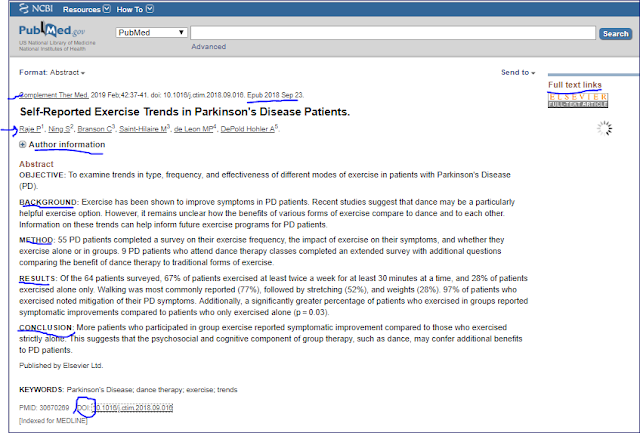
Here's an example of a recent abstract that has been marked to help you identify useful information:
Here are a few things that I do:

Read the Conclusion first (not all abstracts contain these helpful headers, but at least the conclusion will be at the end).  This tells us that:  "More patients who participated in group exercise reported symptomatic improvement compared to those who exercised strictly alone..."  Hm, so pwp are doing better in group exercise.

If I want to know more, I move up to Results.  This tells me some statistics (which I understand some of the time), and more details than the Conclusion. For instance, 97% of those who exercised improved their symptoms.

How was the study done?  How many were involved?  For this, I move up to Method / Methods.  This tells me and number of patients or healthy people were studied, and what action was taken; in this case, it was a survey.

Background will tell briefly about the reasoning or earlier research that lead to this study.

Up at the top are the title and the authors; if I want to know more about who did the research, I can click on + Author Information (in Pubmed, not in the illustration).  At the top is also the journal name and the publication date; often there is an Epub date, date published online, that may be earlier than the "official" publication date. This tells me how recently the work was done.

Often this is enough, but sometimes I want to know more.  For instance, how old were the subjects, or what mix of genders.  Maybe I want to know more about the methodology that was used.  In that case, I need to read the full paper; sometimes I can reach it, either by clicking on Full Text Links (upper right) or on the DOI number (lower left).  Since I've had better luck with the DOI number (Digital Object Identifier), if the Full Text Link doesn't say "Free,"  I click on DOI.  Sometimes all that I can find there is the abstract, but sometimes, with some publishers, there is more.  Some publishers include Highlights, the essential findings, which can be more useful than the abstract for telling about key findings:
Sometimes I can see the full paper, as in this case;  the abstract is at the beginning of the paper, and then the full paper follows.

If I want more, the Discussion section of the full paper often has some of the most interesting material; it's here that researchers often compare their findings to those of different researchers, or reflect on what their results mean.

Sometimes the full paper is behind a Paywall; that means I need to be a subscriber to the journal or a medical/scientific database of these articles, or be willing to pay around $35 to read the paper - which I'm not.  If you think you'll routinely want to read whole papers, cultivate a friend or family member who has access to these articles for their work, perhaps somebody in the scientific or medical field.

I'll be explaining how to evaluate a paper in a future blog post.  For now, post a comment if you have a question, so that I can reply.


Great tools to use during the Pandemic

Some organizations have stepped up for pwp who have lost socialization, and usually exercise programs and support groups.  Even for those ex...