Showing posts with label driving. Show all posts

Monday, August 5, 2019

Dealing with less - less mobility, less independence

I'm chafing.  I fell about two weeks ago, ending up briefly in the ER.  No permanent physical damage, but my confidence is shot.

I can't pretend that the cane is okay any more; probably I was deluding myself.  Yeah, if I could be assured that I would always pay 100% attention, 100% of the time.  Yeah, right.

Fortunately, I have a used rollator that works okay, (and I know how to use it) though it doesn't fold, so isn't great for going anywhere in the car.  I also purchased a new rollator, which does fold, but it weighs a bit more, and I find that I'm so worried about falling when I take out/put back the rollator that I want to hold onto the car with one hand, which really means I don't have both hands free to lift the rollator into the back seat or the trunk.  Which means that I effectively can't drive - independence, I hardly knew ye.  Overnight.  Not ready to stop driving yet.

But I'm walking so tentatively now.  The fall was caused by momentary inattention, not symptom progression.  But I hold onto everything when outside, especially my husband.  And this is made harder by having my left hand in a splint.  But today I took a shower unaided, and got out of the shower unaided  (yahoo!)  Big step forwards.

I've done all the balance challenge exercises that my PT used to challenge me - and I can do them.  Except for the instability pads/stepping stones - so I'm buying those.  It's not my ability.  It's my confidence that s**ks.

I haven't been driving - partly because of the splint, and partly because I know I need the rollator (and even if I could use the cane, I use the cane in my left hand, the hand with the splint).  This has meant an overnight loss of independence which has made me grumpy.  My husband is happy to drive me, but I'm not ready to be that dependent overnight.  This means I need to practice putting the rollator in the car and taking it out.  I know I can do this mentally, but my body isn't quite sure yet. 

Update:  starting to put rollator into back seat, then take it out again.  Yay!  Even drove a little.  Baby steps, but steps!


Monday, July 15, 2019

Travel?

Recently we took a car trip that required 2 days of driving each way.  (Why did we drive?  We have a dog who is part of our family.)

What did we learn?

One of our daughters drove one way with us and helped with the driving.  I no longer do highway driving, which puts the burden on my husband - it takes WAY too much executive functioning/multi-tasking/keeping track of many critical things at the same time.  I could have managed the quiet back roads early in the morning

  • We will start early and get off the road before the afternoon rush hour.

The dog sleeps a lot, but I can't safely walk him because he pulls, which puts extra stress on my husband.  The dog is finding the trips wearing, as he gets older.

  • Since the dog is elderly, and gets worn out by long trips, we aren't scheduling any more driving trips in the near future.

I used my phone to schedule medications, and didn't miss a single dose, but exercise was much harder.  I remembered to do my physical therapy and Qigong, but forgot the cardio, as well as swallowing/voice exercises.  A vacation visit is so shapeless, delightedly so, but that means the usual cues are missing.

  • I need to use my phone to schedule exercise so I remember to do it, the way I schedule medications..  There is also seated cardio that I can do in the car (lots of Youtube videos)

I wore a diaper just in case I didn't quite make it to the bathrooms on time - since when I gotta go, I gotta go right now, and pads might not be quite enough.  As it happens, I didn't need it, but I was glad to have it.

  • I'm going to continue to using the diapers.  Amazingly, these fit fine under my clothes.

We plan exactly what to bring,  complete with a spreadsheet for planning.  This has meant less lugging stuff into the motel room for my husband, but it did take thought, conversation, and trial-and-error.

  • We try to talk about what's working - and not - throughout the trip.
Travelling - and sitting - encourages, um, constipation.  We both get really tired (even though I'm just sitting). 
  • Build in time to use the bathroom.  Less Rush! Rush!
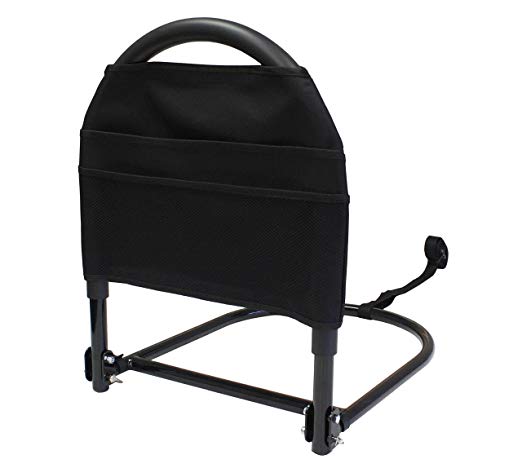
We thought about how flying might bring different issues.  For example, it's easy to throw my bed rail in the car, but it's unwieldy for a plane (but it helps me get into and out of bed, as well as keeping me from falling out).  Questions on a support forum resulted in many helpful responses including:
  • Portable bedrail, check it, send it ahead to the hotel, and the TSA's information about getting through security checkpoints while disabled.  The community rises to the occasion again.
Long trips may not be for us any more, but there are ways to make them more bearable.


Images from Pixabay and Amazon.


Sunday, March 3, 2019

What's wrong with clinical trial process? A participant's perspective

I really want researchers to find ways to slow or reverse progression of the disease, and to find ways to make the many symptoms less bothersome (insomnia, urinary incontinence, lack of appetite...)  So I'm motivated to participate in research (which means clinical trials - see this article for more information).
From PDTrialTracker.Info
Here's what has happened when I tried to sign up for clinical trials:
  • When I was first diagnosed, and not taking any meds yet, I contacted the local research center who said... Oh, we're not doing any studies on PD now.  They could not have sounded more bored.  And though I left email, phone, address, they have not contacted me.  Not once.  In two years.
  • I called a trial in a neighboring state, but they wanted me to go there once a month for a year.  This means my husband would have to drive me at least 12 times, as I can't drive that far any more. (A train takes longer, and unexpectedly requires climbing up or down steps - not remotely disabled-friendly.)
  • When I looked for trials anywhere within driving distance recently, the only trial I could participate in was a 3 hour drive one-way, and required repeated visits.  Not near public transport - and in the middle of nowhere.  Um, who is going to go there?
  • I was looking through trials, and one looked possible, until I noticed that, not only do they want monthly visits, they want to do a lumbar puncture at each visit (that's a puncture of the spine to get spinal fluid).  That means, at the very least, a blinding headache.  I have to ask the clinicians who dreamed this up:  would you be willing to have this procedure performed on you once a month?
  • Tried to enroll in a study about tracking PD symptoms on a Smartphone - twice.  Once was a Samsung phone; one an iPhone.  I had problems with the software on both phones.  Emailed the contact person - in one case, after instructing me to re-install the software, the response was, I guess it doesn't work with your phone.  With the other phone, never got an answer. 
  • Clinicians had come to a local conference of pwp looking for participants in their trial.  It sounded intriguing, and didn't involve any dangerous testing.  When I was screened by the clinician later, because I have atypical Parkinsonism (no tremor, but balance issues), she suddenly wasn't interested.  Well, if you're still doing well in a year, give me a call; if we're having trouble getting participants then we can include you.  That was welcoming.
  • A guy in a suburb of a major city emails me about his trial - 6 hour drive one way - but he thinks I should participate, and be happy to go there monthly.  His tested treatment happens to be known to make another medical condition that I have worse. so I wouldn't consider it; he is sure it's not a big deal and is perfectly willing to risk my health for his trial.  Update:  When I looked up this trial, it wasn't recorded on ClinicalTrials .gov, although it probably should be, by US law.  So who is looking out for the human beings in this trial?
  • I've registered on Fox Trial Finder, as well as several other "I'm interested in participating" websites.  Do I ever hear from any of them about new trials?  Rarely to never.
  • I do hear from one company that does clinical trial work for large pharmaceutical companies.  What they call me about:  Phase 1 trials of some unknown compound; this is a study to find out if the compound is even safe to use.  They seem uncomfortable when I ask the question, "Is this a Phase 1 or Phase 2 trial?" Scientists do Phase 1 trials on a small number of patients, so if it's dangerous, not too many are harmed.  And did I mention that any resulting harm to my health is entirely my problem?  Oh, and it requires a lengthy drive once a week for as long as the trial goes on (which my husband would have to do). Sounds appealing, no?
I regularly look at ClinicalTrials.gov to see what possibilities are out there.  I'm not diagnosed less than 2 years any more, and I'm not "drug naive" (not taking any PD meds); there go most of the trials.  The few I could still participate in usually don't want me because I'm atypical.  There are a few trials I could do if I was demented or having hallucinations (um, no) or if I'm willing to drive for hours weekly.

In sum, besides the almost standard desire for less than 2 years from diagnosis and drug naive, which is a tiny subset of PD patients, there seems to be a willingness to inconvenience the patients (and their families), casually put them in danger, and generally use them and then spit them out.

Pwp who have been through the actual trial process on potential drugs are equally frustrated by disorganized researchers, being cut off from a treatment that helped their condition improve because the trial is over, and then never being told the results of the study - and since 40% of trials NEVER publish their findings, they might never know. Some of these pwp don't want to be used again, and can you blame them? (See some of Christopher Maycock's excellent thinking on this topic.)

What could attract me, and other pwp, to clinical trials?
  • Being treated like a valued customer, not a used kleenex.
  • Recognition that my participation involves inconvenience and possible exhaustion. Telemedicine, anyone?
  • Treat me like an interested partner - I might have insights that could help you reduce the barriers that are making recruitment hard, as well as insights about what success in the trial would mean to me, the PD patient.  
  • Look to include many different kinds of pwp because you don't know which group of us will be helped by your drug/procedure/device. 
  • Recognize that I might be risking my health - and plan for that eventuality with insurance (I should not be out of pocket if I'm harmed).
  • Tell me about your results and what the next steps are.  For example, can I be involved in the next wave of testing? 
  • Provide my physician with all test results and what I was dosed with.  
I don't think any of this is too much to ask.  To their credit, there are researchers that do a lot of this.  Why don't all researchers do this?


Monday, August 13, 2018

Driving with Parkinson's

It's ugly.  One woman posts on a forum that she can only brake if she pushes her leg against the side of the console between the two front seats; should she be driving, she wonders.  For the sake of other people, and herself, I hope she does not.

We lose capabilities over time with PD - sometimes muscular strength (so we can brake in an emergency), sometimes flexibility (so we can turn around to back up safely, and can move our foot from accelerator to brake).  And then there is my personal favorite, multi-tasking (so we can keep track of everything happening around us, keep the car in our lane, keep track of traffic signals, keep track of cars pulling in...)

If we're smart we recognize that some kinds of driving are too challenging, and don't do them - maybe stop driving at night, or when the traffic is heavy, or on highways.  We all know what has become harder.

Many days, for me, getting in and out is the hardest.  Yes, I've practiced pivoting in a chair, but that doesn't have the d**n door in the way! 

AARP has a Safe Driver Course, available to anyone, but less expensive for members; you can take it in person or online. https://www.aarpdriversafety.org/   Although it's oriented to older folks (and though I sure don't feel old, I am one of those older folks), it also looks at disability and the decision to continue driving.

Here's what they cover:
The AARP Smart Driver online course covers:
  • Research-based safe driving strategies.
  • Information on the effects of medication on driving.
  • Preventive measures to reduce driver distractions.
  • Proper use of safety belts, air bags, anti-lock brakes, and new technology found in cars today.
  • Techniques for handling left turns, right-of-way, and roundabouts.
  • State-specific rules and regulations in 19 key areas, including construction zones, child safety seats, school buses, cellphone use and more.
  • Easy-to-follow format incorporating adult-learning principles.
I recently took the course.  I've taken it before (it changes regularly, so much of the course was new).  I wanted strategies that would help me be a safer driver, which was part of the focus of the course.  I've recently retired, so no longer have to drive in snow or sleet  - that means I can avoid driving in challenging weather - hallelujah!  I already avoid night driving and heavy traffic.  Highway driving is exhausting, so I avoid that, too.  I spend time plotting alternate routes so I can avoid challenges.

My husband does the highway driving for us.  I looked into the local Dial-a-Ride, and I've installed the Uber app on my phone, just in case I need it - not cheap, but neither is an accident.  The AARP course also helped me see how much the car is costing (repairs, gas, insurance, taxes...), which makes the alternatives look less expensive.

Each pwp is different.  Some can drive anywhere, any time.   Some can't.  Some will never have to give up driving, but some of us will. We all need to look at this - all of us.

Image from Pixabay

Great tools to use during the Pandemic

Some organizations have stepped up for pwp who have lost socialization, and usually exercise programs and support groups.  Even for those ex...